
Listen here to Ghalia Benali collaborating with Belgian, Iraqi, Moroccan and Indian musicians to produce a uniquely Arab-Indian-International blend of music that’s beyond mind blowing. The album is called Al Palna (Palna is a Hindi word meaning ‘Cradle’) and she is singing a track titled Hayyamatni. (you can listen to Ghalia and Dina al Wedidi singing the same track but without the Indian instruments live in Cairo in 2013 here)
Ghalia Benali is a Tunisian singer, songwriter, dancer, design artist and performer, born in Brussels in the late sixties. She grew up in Zarzis in southern Tunisia, and returned to Brussels to study graphic design after completing high school. She embarked on her musical career in the nineties and soon climbed to fame abroad. She has this hypnotic voice, nuanced, deep and passionate. I remember reading somewhere that a soprano is not the natural range of most Arab female singers, they tend towards the alto. I haven't been able to discover why that should be so, but I am happy that it is, if it is. Just a personal preference, nothing to do with the quality of their, or anyone else's, music.
Ghalia is a self taught musician, influenced by not just the Middle Eastern greats, but the cross currents of world music that ebbed and flowed all around her in her formative years. Her mother listened to Indian and Arab music, her father favoured Western classical, she herself was exposed to Middle Eastern folk traditions and other musical ones rooted deep in the cultural fabric of her native land. As a result both the East and the West and the Middle meet in her art.
Holidays. A certain, sudden spring. And the making of both.

Galal Amin is a well known economist, and has taught at both Ain Shams University and the American University in Cairo. He has also been visiting faculty at US universities. He is a serious social commentator but his essays are threaded through with a dry wit, quite delightful, while being informative and intimate.
Socially speaking, summer holidaying in Egypt has been characterized, like many other aspects of social life, by a striking dualism reflecting an obvious contrast in the way of life of the upper and lower classes. No wonder that Egyptians have coined several words based on the noun for summer season, sayf. Thus, where an English- or Frenchman would speak of "taking his holiday," the Egyptian speaks of tasyif, "summer holidaymaking," which means specifically, spending the summer at the seaside. Egyptians even have a special noun for people who spend the summer this way: mustafin or musayifin, as well as a word for the summer breeze, meaning, literally, the "breeze that comes from the direction of the sea," bahari, whose praises are continually being sung. Egyptians attribute to it the power of restoring the soul and of healing the sick, they may even entrust it with carrying messages to and from a beloved person.
As a non-Arab and a Desi, I can tell you I am into waterscapes (I was born on the East bank of a river, not far from the seas) and so I get this - Egyptians are inordinately fond of waterbodies. Most Arabs are, considering much of their lands are arid and inhospitable. So that's no surprise, all humans probably have this affinity for water, given that they...um...promptly perish without the sweet version of that commodity. But extolling a particular kind of breeze? and assigning it a postman role for love notes? So totally charming, so Egyptian! And also - Indian.
Ghalia is a self taught musician, influenced by not just the Middle Eastern greats, but the cross currents of world music that ebbed and flowed all around her in her formative years. Her mother listened to Indian and Arab music, her father favoured Western classical, she herself was exposed to Middle Eastern folk traditions and other musical ones rooted deep in the cultural fabric of her native land. As a result both the East and the West and the Middle meet in her art.
Holidays. A certain, sudden spring. And the making of both.
The
Arab Spring came to Egypt in January 2011, on a day that my child returned from
a school trip to Luxor. A handful of parents, just those of that particular year
group, went to pick the children up at nightfall and waited and waited in the dimly
lit school grounds. An empty school devoid of the happy bustle of learning and
light is one of the most forlorn places to be. We rattled around, tired,
impatient, bored and fed up already. The teachers texted almost continuously and
conscientiously about the snarls and the protests blocking the main highways. I
was probably not at my patient best.
They
finally came in at around ten, three hours late. We thought nothing of it at
the time, Cairo traffic has a formidable reputation in the congested
department. And the airport was 50 km away from us. Then things took a
scary-beautiful turn a few days later. The anger escalated, the protests
continued, we were evacuated, the President fell. And returning, I saw graffiti for the first time
in Cairo streets. The Revolution ultimately failed, but not before it created a
lava explosion of art – visual, audio, written, performed. Watching a
revolution unfold is a concentrated life lesson, whether you are a part of it
or just a bystander. Two personal milestones happened unobtrusively during that
time, my child spent his first night away from his mum, he and I both grew up a
little, and my book of Bengali shorts was published during the Kolkata Book
Fair in January 2011.
That whole year was a concentrated learning opportunity in ways more than one. Tagore’s
150th birth anniversary was being celebrated and the Indian Embassy
in Cairo organised a yearlong fiesta of his works, documentaries, poetry
readings, seminars analysing his life and times. I went along for as many of
them as I could, obviously. One particular literary event stands out – a seminar
on the poetry of ‘Tagore and Shawky’ – not only did I get to know about the
correspondence between the Egyptian poet Ahmed Shawky and Tagore, I heard
living, established Arab poets recite from Tagore’s works, their own works,
past Arab greats, a veritable bonanza of poetry. All that year my newsfeed
had translated snippets from Gitanjali posted by Egyptian friends; an Egyptian
who had lived in Bangladesh stood up and declaimed a Tagore verse, impromptu, at
one of the events, complete with the Bengali accent; someone sent me cuttings of past
articles in Cairo newspapers on Tagore - ordinary people, not poets and intellectuals
superkeen on the arts or anything. I had no idea the following Tagore had among
Egyptians and I was blown away.
That year was the first time I heard of Prof Galal Amin too. He was the main speaker in
one of these events.
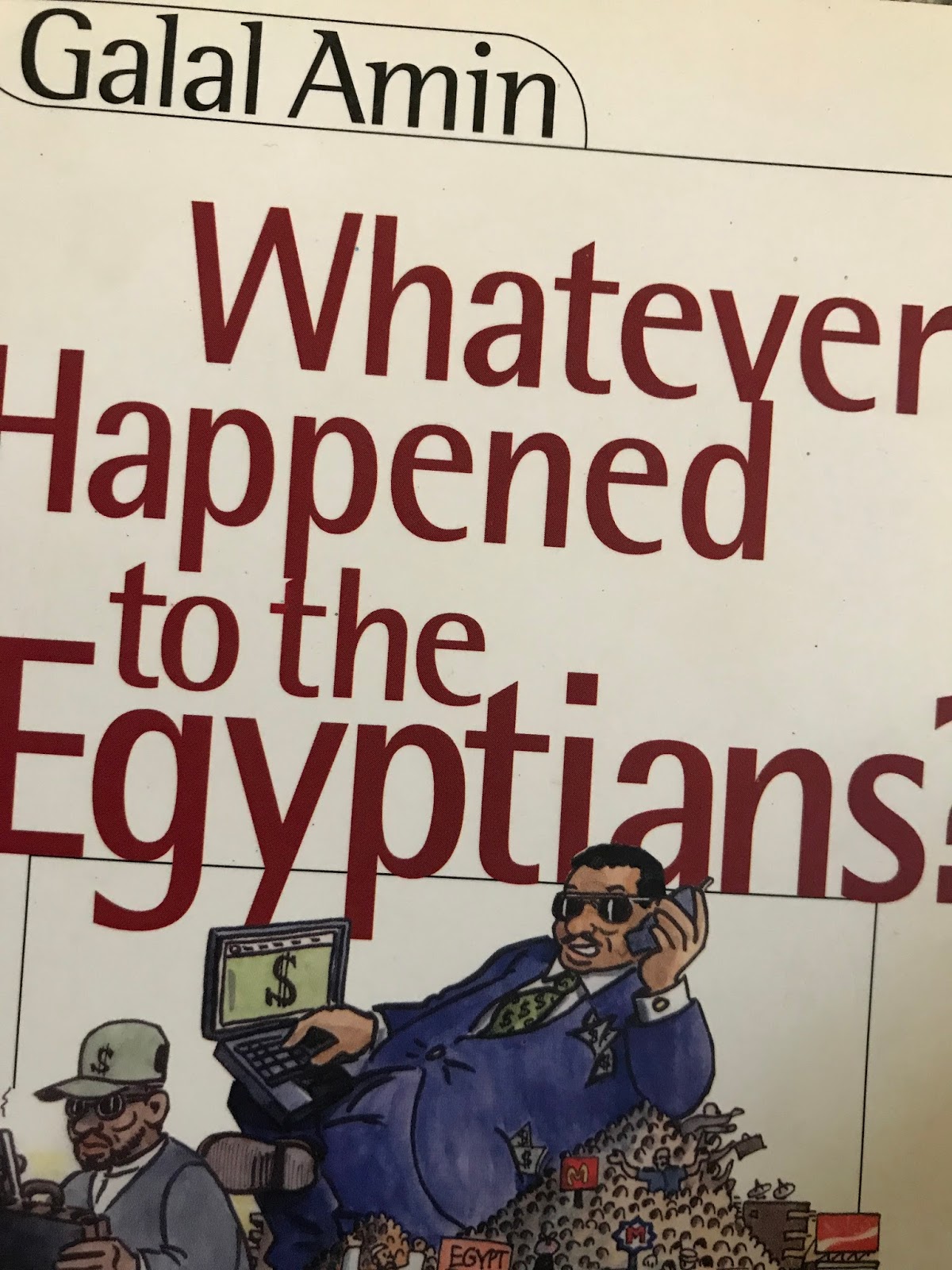
Socially speaking, summer holidaying in Egypt has been characterized, like many other aspects of social life, by a striking dualism reflecting an obvious contrast in the way of life of the upper and lower classes. No wonder that Egyptians have coined several words based on the noun for summer season, sayf. Thus, where an English- or Frenchman would speak of "taking his holiday," the Egyptian speaks of tasyif, "summer holidaymaking," which means specifically, spending the summer at the seaside. Egyptians even have a special noun for people who spend the summer this way: mustafin or musayifin, as well as a word for the summer breeze, meaning, literally, the "breeze that comes from the direction of the sea," bahari, whose praises are continually being sung. Egyptians attribute to it the power of restoring the soul and of healing the sick, they may even entrust it with carrying messages to and from a beloved person.
~ Whatever Happened to the Egyptians, Galal Amin
As a non-Arab and a Desi, I can tell you I am into waterscapes (I was born on the East bank of a river, not far from the seas) and so I get this - Egyptians are inordinately fond of waterbodies. Most Arabs are, considering much of their lands are arid and inhospitable. So that's no surprise, all humans probably have this affinity for water, given that they...um...promptly perish without the sweet version of that commodity. But extolling a particular kind of breeze? and assigning it a postman role for love notes? So totally charming, so Egyptian! And also - Indian.


