Showing posts with label Van Gogh. Show all posts

Wednesday, 17 June 2020

Write...Edit...Publish... + IWSG June 2020 : Urban Nightmare


It's time to get back to Write...Edit...Publish..., I do hope all WEPers are coping and doing well.   Keeping in mind the ongoing pandemic situation and the personal challenges we are all facing, WEP is going Lite this month. I'm sticking to my comfort zone of photo-essays, aka non-fiction ramblings. I have done better this month on the wordcount control, finally! -  


Pigeon. Panic. Pandemic. 


There is nothing you can see that is not a flower; there is nothing you can think that is not the moon.
~ Matsuo Basho

Right in the middle of the urban nightmare to beat all nightmares, the pigeon desperately wants to fly home. But it can’t. Borders are closed. The mind can go wherever it wants, it can think only flowers, it can think beyond the moon, it can morph into whatever it desires, but the body? The body is governed by the natural laws, physics and biology and biochemistry and abstruse electrochemistry. It is subject to boundaries both physical and geographical. There is no shaking off its shackles. There is no escape from this city. And so it burrows back into the mind, where it can devise its own escape and try on the grasshopper wings again.


Credit: View from Studio (1886)


The rise of the city is inexorably linked to settled agriculture. And art as we know it today is linked to it as well. If there were no public buildings – the monuments, the necropolis, the places of worship, the town square, the library, the parks, as also the private grounds and the sitting room, there would be no need to hang art on walls or install statues or design frescoes and fountains and what have you. The beginnings of Homo sapiens’ art, as with most other beginnings, lie in Africa, in Tan-Tan and Blombos. Some of the prehistoric art we have remnants of, were either made to decorate living humans with – beads and a mix of pigments to hang around and ornament various limbs; or were independent free standing, portable figurines. A purely nomadic hunter gatherer life does not lend itself to monumental art for obvious reasons. Rock art which dates from around 35,000-40,000 years ago or even 200,000 ya is clearly an attempt to beautify or glorify a cave/surface which humans were at for long enough to create those artworks. Therefore, we can safely assume that though art happened pre-agriculture, wall art required a surface that humans stayed put at for some time or they knew they would come back to. If there are no walls, they can’t be decorated, right?


The ancient cities rose on the back of the Neolithic Revolution – or settled agriculture, in the region commonly known as the Fertile Crescent. The oldest cities such as Jericho (9000 BCE) and Ur (6500 BCE) coalesced along its curve. The first writing and recordkeeping happened in Ur in fact, slicing off the ‘pre-‘ from prehistory in one fell swoop. Cities were predicated on an agricultural surplus and humans changed profoundly, from foragers into a society based on specialisation of labour. Not everyone needed to be growing food, so some turned their minds and skills to other things. A non-farming class of residents - that of the artists/artisans – grew as a corollary to settled agriculture.


The earliest civilisations rose out of these communities in the river valleys of Mesopotamia, India, Egypt and China. Settled agriculture meant an exponential growth in the population, as the same piece of land could now support many times the original inhabitants. As the civilisations grew, their cities became political capitals, centres of education, trade and commerce hubs, forums for artistic and creative exchange. But there was also a price to pay for this luscious, spanking new lifestyle. An organised society meant more rigid class divisions and inequalities leading to high crime rates. Living in close proximity meant higher pollution, and last but not the least, diseases on an epidemic scale. The urban nightmare started early - from ancient times.


***


Normality is a paved road: it’s comfortable to walk, but no flowers grow on it. 
~ Vincent van Gogh.

Vincent’s nightmares were both urban and various. The most famous of them is the ear incident in Arles. That happened after a heated debate with Paul Gauguin. But there are others as well. Let the grasshopper stop whirring about for a minute and recap his time in Paris.

In 1886, Vincent moved to Paris where his brother Theo was already working at an art dealers. Paris had acquired the reputation of being the art capital of Europe in prior centuries. By the time van Gogh moved there, it was in its artistic prime – it had some of the finest painters and the art schools associated with them. Paris was the centre where several art movements – Romanticism, Impressionism, Cubism, Fauvism, Art Deco etc evolved. Van Gogh arrived in Paris splat in the middle of the Impressionist movement - Monet and Pissarro were already established. Vincent admired the old masters he saw in the Paris museums, at first he didn’t like the Impressionists much. But that changed a year on – he started experimenting with the loose brushstrokes and lighter, brighter colour palettes of the Impressionists. His art evolved at an exponential, breath-taking pace. He worked in the studio of Fernand Cormon and found inspiration from his circle of artist friends such as Emile Bernard and Paul Gauguin.

However, living in Paris drained him, even as it elevated his art and grew him as an artist. He smoked and drank too much, ate poorly, the pace of the big city wore him down.

It seems to me almost impossible to be able to work in Paris, unless you have a refuge in which to recover and regain your peace of mind and self-composure. Without that, you’d be bound to get utterly numbed. 
~ Letter to Theo van Gogh, Arles, 21st Feb 1888

I could never get used to climbing the stairs in Paris, and was always dizzy in a dreadful nightmare that has left me here, but recurred regularly there. 
~ Letter to Willemien van Gogh, Arles, June 1888

The self-portrait he painted in Paris reflected this, he looks exhausted and depressed. And he described it as such to his sister Wil ‘with…wrinkles in forehead and around the mouth, stiffly wooden, a very red beard, quite unkempt and sad.’

Credit: Van Gogh Museum, Amsterdam


Paris ultimately gave Vincent the artistic lift-off he had sought, but he had had to pay a heavy price. 


Always a heavy price. Whether as a heedless species traversing the broad arc of history; or a single, keenly aware individual, a misunderstood genius ahead of his time, trying to make a little space for his art.


WC - 1054
FCA


Read the other entries below :

Wednesday, 15 April 2020

Write...Edit...Publish...+ IWSG April 2020 : Antique Vase


It's been a particularly godawful time between the last posting and this, so it's a relief to get online and get posting for Write...Edit...Publish..., phew! I hope all of you are hunkered down and socially distant, keeping safe and well. These past few weeks have made yet another advantage of WEP further clear to me - it's pandemic proof! 

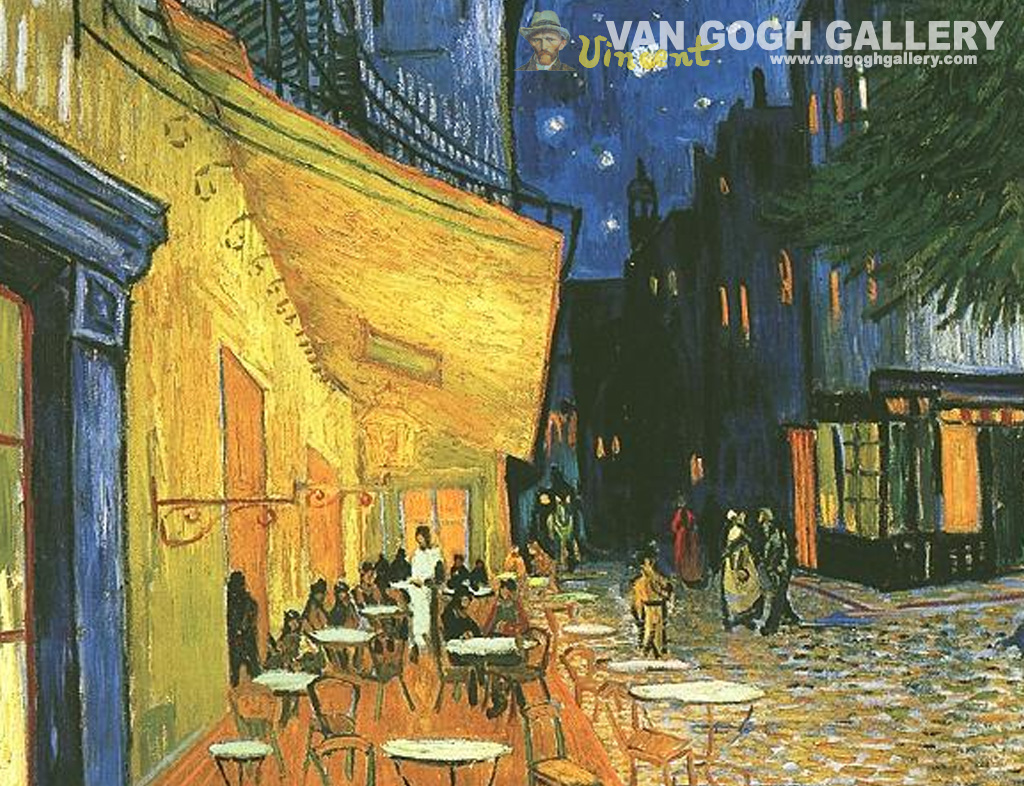
I'm still kind of hungover from the previous posting, where there was an outpouring of fanwork based on  Vincent van Gogh's Cafe Terrace at Night.  So I let my mind wander in the same directions for this challenge too, but as usual my wordcount control is pathetic. So the 1000 wordstone is embedded within the text, read till there or go beyond as you wish, totally up to you. I would have split it into two, but what with the ongoing A-Z, I know I'd never get around to posting the second part. So, here goes -


The Grasshopper. The Pigeon. The Bulldog.

The usefulness of the pot lies in its emptiness. ~ Lao Tzu, Ancient Chinese philosopher.

Sunday, 23 February 2020

A Short History of Cafe. Terrace. Alfresco. Street Lighting. Pigments. And Nocturnes. Part II


Continuing the entry from Wednesday...read the first part here.


Credit


The Oxford students took coffee to London as well, where coffeehouses gained widespread popularity as Penny Universities because all kinds of subjects were discussed by men from all walks of life. No women allowed in though. The ladies soon set up a petition – complaining that coffee decreased their men’s virility. Men fired back a vigorous and somewhat explicit rejoinder.

Wednesday, 19 February 2020

Write...Edit...Publish...+ IWSG Feb 2020 : Cafe Terrace


It's time for the inaugural post for the year at WEP, but it's not any old year. WEP hits a major milestone in 2020, the tenth anniversary, wow! We've come a long way together, WEP and M-i-V. I can't believe it still, the way time flies. Thank you, Denise and WEP, for the badge and the fun and the learning.

I've been a bit ambitious with this prompt and spectacularly failed to trim my post to the required wordcount, so it's broken into two parts. The first appears for this challenge, the concluding part will go live on Sunday. 


A Short History of Café. Terrace. Alfresco. Street Lighting. Pigments. And Nocturnes. (Part I)


So I could have told you how I went to MoMA without checking, unpardonable! - and found it closed for renovations. No shufti at a famous Night, no nibbles at Terrace 5. But I won’t. Let’s begin at a different point, away from the nights, away from shuftis, and most of all, away from me. Bored with staring at millions of my own reflections in the sheesh mahals of my mind.  Let’s start with…this mug beside me. With café. Which is the French word for coffee  - absorbed into other languages to sometimes mean the beverage and/or the place where it is drunk.

To do good work one must eat well, be well housed, have one's fling from time to time, smoke one's pipe, and drink one's coffee in peace.

~ Vincent Van Gogh

Coffee. It’s another religion started and propagated by Arabs which took on a life of its own, left them behind and happily traversed right round the world. Just like the other one did. Every single country in the world consumes coffee, I kid you not. And clearly coffee has done relatively better for itself than the other faith propagated by Arabs,  it’s bagged more converts and has less phobia and misconceptions attached. But it wasn’t always so. Coffee’s got enough bad press in the past, down to 17th century ladies in London protesting it was an anti-Viagra kind of stuff, if you know what I mean. But I’m getting ahead of myself.


Things kick off around 850 CE in Ethiopia. Because you know, all the good stories start in Africa. A goatherd – yes, all good stories will also have an animal flock tucked in somewhere – well, a herder called Kaldi notices his flock ‘dancing’ after they’ve munched on some berries. He takes the berries to a monk, who disapproving, throws them into the fire, whereupon issues the most delicious aroma. Other monks come to investigate, retrieve the roasted beans, grind them up and brew the first mug of coffee. This is the first reference, in a book written by a Lebanese professor of languages in Rome in 1671, of the origins of coffee. And since it is almost nine centuries that Kaldi and party have proceeded to the great café in the heavens, this is taken to be apocryphal, a legend. Except in Ethiopia, where it’s treated with due seriousness as history and where both Kaldi and The Dancing Goat are two popular names for cafés, with or without terraces.


***

Talking about terraces, I could have told you too, about their role in my childhood. The first hailstorm I watched happened on one, a small internal terrace filling up with hailstones one winter in front of my five year old, delighted-astonished eyes. About sleeping on them on summer nights on charpoys - all of Delhi did that in the 70s and 80s, don’t know if air pollution, crime and sophisticated, modern lifestyles allow that anymore?


Terraces go back much further than cafés. In architecture, they happened with the building of the first shelters. There’s archaeological evidence from ancient settlements dotted around the Levant, the oldest one dated to Palaeolithic times. Somewhere south of Haifa in Israel is a village consisting of a cluster of 12/13  subcircular houses set on artificial terraces, constructed around 10,000 BCE. Clearly, humans have always enjoyed sitting around outdoors and sipping whatever beverages were in vogue, from the earliest hours of civilisation. And alfresco dining is thought to have originated with a quick filler of baked pastries and meats before people set off on hunts in medieval times. Which then developed into more elaborate picnics by the 18th century, as pleasure gardens, public parks and outdoor spaces were developed. But eating outdoors for pleasure or as a leisure activity was restricted strictly to the upper, more affluent classes. The peasant farmer, the fisherman, the shepherd would naturally eat their slice of pie out in the open, but that came with the job. In the early 20th century, the automobile sparked off a sea change in lifestyles as more and more people could travel further afield. Day trips became part of the repertoire of family activities and work groups, picnicking boomed. The accessories available also became more elaborate and so the hasty baked pre-hunt snack of medieval times became a full-fledged formal meal taken outdoors. Okay, now back to coffee.


From Ethiopia Arab traders brought it to Yemen, where it caught on with the Sufi monks – they drank it to stay awake through the nights. The Arabs called it qahwah – that which prevents sleep. Qahwah became popular with ordinary folks too, especially during the month of Ramadan, when people stayed up deep into the nights for prayer and entertainment. Mocha, an important trading port in Yemen, became a focal point in the coffee route. By 1450-ish, the Ottoman Turks had  taken coffee to Istanbul  where the first cafés, called qahwah-khane, opened. From there it was a small step to Cairo and to Mecca. The qahwah-khanes became a focal point where people gathered not just to drink coffee, but also to discuss, debate, write about the hot button topics of the day. They became so popular that the Governor of Mecca abolished them fearing the vigorous discussions and dissent would disrupt his rule. Unrest broke out far and wide,  the Sultan was finally forced to intervene. He restored coffee to the public and order in the empire. Coffee was thus established in the Muslim world. Up to late 16th century cultivation was kept a closely guarded secret. Exports of fertile beans were prohibited.


However, a subcontinental chap smuggled back some beans after a pilgrimage to Mecca in 1600. Coffee cultivation  thus started in India. And in Europe, coffee made its way through trade first to Venice. Later the Pope took a sip and became a fan.  The first settlers took coffee to Americas in the early 17th century, and by mid-17th  a coffee club was set up in Oxford in England  – the first members included luminaries like Edmund Halley and Isaac Newton. This matured into the leading scientific think tank of Britain – the Royal Society...


WC - 991
FCA


It often seems to me that the night is even more richly coloured than the day, coloured in the most intense violets, blues and greens. If you look carefully you’ll see that some stars are lemony, others have a pink, green, forget-me-not blue glow. And without labouring the point, it’s clear that to paint a starry sky it’s not nearly enough to put white spots on blue-black.

Letter  to Willemien Van Gogh, dated 8th-14th Sept, 1888, Arles.


Credit. In some kind of a cosmic coincidence, Kirk Douglas passed away earlier this month and so prodded me into watching the Van Gogh film, Lust for Life. My interest in Van Gogh started with the  original title, the book by Irving Stone (1934), which got made into the film (1956). Kirk Douglas is uncannily similar to the maestro though the film differs a bit from the actual life events of the artist.  Also itching to watch the more recent film - Loving Vincent, when I can access it finally.

Read the other entries below -