Showing posts with label history. Show all posts

Wednesday, 15 April 2020

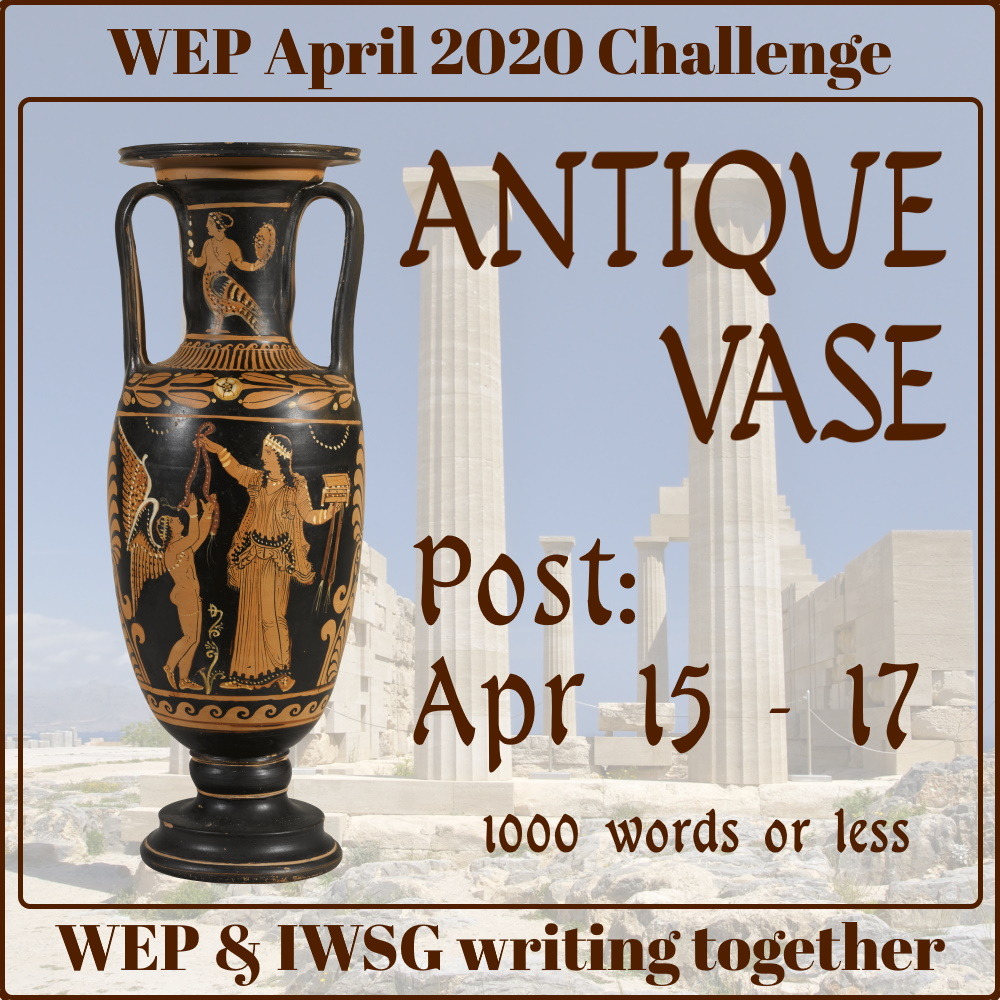
Write...Edit...Publish...+ IWSG April 2020 : Antique Vase


It's been a particularly godawful time between the last posting and this, so it's a relief to get online and get posting for Write...Edit...Publish..., phew! I hope all of you are hunkered down and socially distant, keeping safe and well. These past few weeks have made yet another advantage of WEP further clear to me - it's pandemic proof! 

I'm still kind of hungover from the previous posting, where there was an outpouring of fanwork based on  Vincent van Gogh's Cafe Terrace at Night.  So I let my mind wander in the same directions for this challenge too, but as usual my wordcount control is pathetic. So the 1000 wordstone is embedded within the text, read till there or go beyond as you wish, totally up to you. I would have split it into two, but what with the ongoing A-Z, I know I'd never get around to posting the second part. So, here goes -


The Grasshopper. The Pigeon. The Bulldog.

The usefulness of the pot lies in its emptiness. ~ Lao Tzu, Ancient Chinese philosopher.

Sunday, 9 June 2019

Fifty Percent


VIII.

Tell me about the skilled women
who dye the cloth and spin the yarn,
who raise the invoice and basins,
who love and break and mend and darn

and yet they tread so light footed,
their prints are easy to wipe off;
the jingle of their anklets fades -
it rings just once and then it stops

and when the book’s opened again
there is no trace left on the page -
the work they did, the yarns they spun
are rubbed out of the percentage.

Speak of the quiet fifty percent
who’re rubbed out, the erased segment.


Last week, I posted a sonnet from a series I am working on - Ninety Nine Percent, and Elephant's Child commented - 'And teach me about women, whose work is both imperative for our survival and so often ignored.' Which was super uncanny because....!! well, great minds and all that... :) 

So I thought I'd put it up. 


Sunday, 2 June 2019

Ninety Nine Percent


Teach me instead about peacetime,
the chaps who did not go to war,
the peasant folk who stayed at home,
who tilled the land and manned the store.

Tell me about the millions who
toiled ceaselessly, but left no mark.
The doormen of old neighbourhoods.
The fishermen out in the dark.

Spell out the history of small men
whose footsteps wore out cobblestones -
the mason, the cook, occupations
that did not involve crowns and thrones.

Speak of the ninety nine percent,
and tell me how their lives were spent.


Sunday, 25 June 2017

Malfuf wa Malik : ...and Backstories...


Sometime in the mid-noughts, this song by Nancy Ajram was released. Nancy comes from Lebanon and is a very popular singer in the Arab world. She started her singing career in the late 90's while she was in her teens, and has sold many millions of records since. She has been the World Music Awards recipient multiple times, mentioned by Oprah as an artiste of note, and has also been the UNICEF ambassador in the ME. By rights she should have totally been part of the A-Z series, I don't know how she never made the cut, very remiss of me! Correcting that now - take a listen -


Finding Bernie

Around the time this song was released, we were relocated to Dubai after eight eventful and memorable years in Bahrain. Much had happened here to make me feel settled. The arrival of my son was the biggest life event of them all, I went back to India for the birth and stayed for a longish time. And realised how much of me felt out of place away from Bahrain even though I was technically ‘at home.’


Therefore, it came as a shock how pleased I was at the news of the new posting. I loved our life in Bahrain, we had each slotted into our individual places. It was weird, this pang of pleasure we were going to a new city, albeit not too far from Bahrain, but vastly different in terms of the looks and the vibes. Dubai had been for all those years our transit hub, we changed for the flight to Kolkata there every time we went back.  We had visited there too a couple times, and I hadn’t liked it much. Even weirder, considering.

Friday, 14 April 2017

L is for Latifa...and...Language...and.. Loanwords


is for
Latifa, a Tunisian artiste, with her number Bel Arabi (In Arabic) 


Language


The history of spoken language, or when Man first developed the ability to organise sounds into words, will always remain obscure.  Historians guess that humans used spoken language a million years ago, albeit with a slower delivery, smaller vocabulary, and probably their grammar wasn't quite as dishy. 


In contrast, individual languages, which have descended from a common ‘ancestor’ language can be traced and their origins pinpointed with slightly greater precision. There are some 5000 languages spoken in the world today, linguists group them into roughly 20 families. 


The Semitic family of languages is a serious biggie in west Asia, waaay back then and now. It’s descended from the language of nomadic tribal groups of one place, yup, you guessed it, from Arabia. 


By about 3000 BCE these Semitic group of languages are spoken all through the desert tracts of Southern Arabia and in the Northern Levant. One of them – Aramaic becomes the lingua franca of the Middle East. And then Arabic develops, from Aramaic into Nabatean, and from Old Arabic, culminating finally into its present form in the 7th century.


Ancient spoken versions of Old Arabic can be traced back to at least the first millennium BCE, but probably were in use for centuries before then also. Old South Arabic has been traced to the 10th century BCE, while Old North Arabic can be dated at least as far back as 6th century BCE. 


As with the spoken language, the exact dates when the script developed are also blurry. Some scholars think the origins can be dated back to around 2500 BCE, others date it to 1800-1600 BCE.   What is clear though, is that this here lingo is seriously ancient. Arabic has some deep roots.


Loanwords


Now the Arabs clocked up some impressive mileages from antiquity due to trade.  And by the middle of the 8th century, within a century of the founding of Islam, the new faith had spread by conquest to include much of North Africa to the west, and right upto the borders of China towards the east.  Later, the empire went onto Spain and Sicily and brought them into its remit.

From Zarafa in Arabic to Giraffe in English. 


This took Arabic far from the lands where it originated, and it left its mark on those cultures. A whole bunch of loanwords got incorporated into all manner of languages – European (English, Spanish) African (Kiswahili, Hausa), Asian (Turkish, Persian, Indonesian) and South Asian (Urdu, Hindi, Punjabi, Bengali).


And because there were some incorrigibly nerdish types in those initial centuries of the Empire, researching, ferreting out stuff and expanding human knowledge in astronomy, mathematics, chemistry, botany, medicine, architecture…and by then Arabic was the language of scholarship, the nerds used it extensively, therefore, Arabic influenced scientific nomenclature in major ways. Many plant names, material names, mathematical and architectural terms have been adopted from Arabic into English via medieval Latin.


From Qat in Arabic to Cat in English.


Some examples of everyday words that have Arabic roots –


Alcove (al-Qobba) Aubergine (al-Badinjan) Cipher (Sifr) Gazelle (Ghazal) Albatross (al-Ghattas) Sugar (Sukkar) Cotton (Qutn) Syrup (Sharab)  Azure (al Lazaward) Caravan (Qairawan) … there are hundreds more.


Did you know that Spanish has Legions of Arabic loanwords, more than any other European language, because of the Long Muslim rule in Spain?  


Posted for the A-Z Challenge 2017 


Monday, 3 February 2014

Foggy lakes


Silence among the ruins, the crows -
staunch friends - sit solemn on a lintel
in ceremonial blacks and indigos
against the stone-chapped lips of winter.
Ruby dreams once sewn in tailors shops
laidback needles in the spider webbing
of satellite cables digitised dull props
delicate necks of cranes, high-stepping
giraffes and slow moving meddlemen.
narratives won’t be forced into neat queues,  
garlanded with marigolds, chillis and lemons
on chilly mornings of foggy lakeviews,
dipping and bowing to crows and humans.
There isn’t any order to a timeless world.


Friday, 3 January 2014

Excerpt : Alexandria


The eastern harbour.  The lighthouse that fell
the stones configured now to a citadel -
the guide’s laconic. Meanwhile, some of the city
has been clawed by the sea into its depths
cobblestone streets gobbled, the warp and weft
of grand architectures of peace and probity.


There’s nothing remotely romantic about
a lighthouse, the strongest beam shines out
not as golden hope, bloody fancy metaphors!
just a plain warning, turn away, keep off,
keep off the grass, the rock, this shore, don’t stop.
The moth and flame in vaguely shocking reverse.


The bunched weight of history easily slips
like a tote-strap off shoulders, no way to grip
it simply. Teenage kids high-five on the pavement.
A black and yellow waspish cab in cruise mode
rubs up slow against the kerb. The waves erode
the rough shoreline till the backwash is spent.


Sunday, 28 April 2013

Ashoka, after Kalinga


The few who return home from here
will never again be quite whole.
Combat zones. Courage and fear.
So many ways to shrink the soul.


Not just flesh that is sliced open,
it’s not just bodies that blades maim;
violence plants its secret weapon
and those that return won’t be the same.


The tips of arrows, heads of spears
end of day are plucked from skin;
but war is too hard to pluck clear
from the heart once the blade goes in.


There could be other paths, directions,
fields, where it’s not this one battle
and maybe they too change a person
they’re not the same once they travel;


I’ll take that road and see for myself
if peace can be found a different route,
if a change in travel plans will help
and a war-free way to be will suit.