Monday, 13 August 2018

Poetryless and up to my eyes


Long time readers here know that I'm hooked to the A-Z, and the Write...Edit...Publish... blogfests. And I'm hooked to MOOCs, I'm a compulsive MOOC-taker, they have become a part of my summer since I did the first one in 2016. But this year was different, I knew I'd be away for a large chunk of time bang in the middle of it, moving around every 4-5-6 days without much chance of you know, writing things down...So of course I signed up, for this one here!  

Predictably, I am now up to my eyes trying to catch up. I am a retreating speck in the rear view mirrors of my coursemates, if I may borrow my own phrase from last week :) Therefore, no poetry here today. Just an excerpt from the story I'm developing over there, and a hint of what is to be my entry come Wednesday for the writing challenge at Write...Edit...Publish..., teaming up with the Insecure Writer's Support Group for an exciting partnership. 


Insomniac 

The heart never sleeps, there is no rest. And the heart of the city certainly never sleeps, even in the smallest hours of the night. You have spent your whole life here but have only now fully realised it.  Because you can’t sleep a wink tonight, can you? how can you sleep when years of a monumental struggle are finally drawing to a close? What if you close your eyes and then when they open again, the entire prospect has vanished like the dream it feels it is? You can’t take that risk. So you listen for the heartbeat of the city, imagine another heartbeat on a monitor, steady, evenly fluorescent green lines sweeping across the screen while you listen to the sounds here and now – the noises of the ever-awake, insomniac inner streets.

Everything has its own sound here, the day and the night. Nothing is perfectly silent. Especially not the night. Even the streetlights are not silent, they hum with a quiet hum as they burn, each in its own whirlpool of flying insects. You aren’t sure if that noise is the electricity changing to light, or if it is the bugs flying around them.

You have gone along with a false notion mindlessly – silent night, no, it is not silent.  Just because the cars are parked and shut away in garages, only the night buses run and the metro stops throbbing through the subterranean veins of the city - that doesn’t equal quiet. There are the cicadas. Nothing silent about them.  As the vehicular noise recedes, they come into their own, their choral songs becoming louder and more attention seeking. You notice a night jar calling, a sparrow flaps its wings at its roost, disturbed by something. Do sparrows dream, you wonder. Is there any way of knowing the dreams of birds? Does a racing heart mean the same thing in birds as it does in humans? Your heart is racing tonight, equal parts excitement and fear. You try to breathe slowly, breathe in, hold, count, breathe out. But your heart doesn’t pay any mind to your exercises in control, it beats independently at a rate of its own choosing.

The night watchman blows his whistle right under your window every half hour as he completes his beat. His stout steel tipped stick rings on the asphalt and on the pavers bordering the kerb in a steady rhythm. It recedes as he moves to the outer edge of the block and then washes in as he completes the loop again. Somewhere a leaky faucet’s dripping – drip, drip, drip-drip. It is too faint to be one of yours, but you still get up to check, it is something to do, a diversion and a relief from your relentless, intense happy-panicked state of mind. You tighten the faucets quite unnecessarily before you come back to bed. The wood creaks as you lie back on it.

A street mongrel barks at a carful of revelers retuning from some late celebration, their audio is unnaturally loud in the absence of traffic. The glow of their headlights strafes the darkened walls of your room in an eerie sweep. Someone’s grandfather clock chimes the hours – the sound wafts in weakly through your open window. You count them up first – one to eleven, one to twelve, it drops to one. And then it rises again - one two, one two three, one two three four, you hear the first tram go clanging past at half past four. Someone is chanting the Krishna-naam rather loudly on it as he goes down to the river. Hare Krishna, Hare Krishna, Krishna Krishna, Hare Hare.

You pick out that chant and give in to the impulse of touching your hand to your forehead in reverence to gods till now unknown to you, because you must take every opportunity to appease them. Is this hypocrisy? Praying only at a crisis? Maybe it is, but you don’t care. The second tram clangs past. There is no-one chanting on it, you can make that out as well. You didn’t know you had this acute a sense of hearing. You are hyper-alert to each sound, and the sound of your own pulse in your ears is the loudest of them all. 

The sunlight is just tickling the window now, the curtain cracks open in a hairline smile. The sparrows are stirring in the nest they have built in your skylight.

You were gone for so many days, toing and froing from the hospital, panic-stricken and hope-stricken and disbelief-stricken by quick turns, can it really end – surely you were not destined to be this happy? Skylights and birds and the general cleanliness of the household were very far from your mind, so that by the time you returned to yourself and your balcony, and you chanced to look up, oh heavens, the female was already sitting on the eggs and the male was hovering around practicing helicopter parenting.

You have a staunch heart but it balked at having to break that nest.  So you left it there.

And all this time, with the screens of the fluorescent green lines bleeping in rooms far away, your home has been empty of you, but home to new hearts beating. Your balcony is now fouled with bird droppings and sundry other messes.  You don’t really mind, who has time for fussing when something this big is happening in your life? 

You’ll take balconies with or without birdshit now, forever. You’ll take whatever other shit the balconies have in store for you. Just let this one thing be true. Just let this not be a dream. Just let Mohan come home. 

~~~


And if I may, I'd like to ask you some of the questions that I'm facing from the TAs in the forums - does the use of vernacular terms put you off? Or does it make the writing feel more authentic? Should we as writers consider the readership we are writing for, or should we just forget about them and create the art we want to create? 

For those who write in a second language, as I do, should they be cautious about first language interference, or even first culture interference?

Thank you for your patience with this one. 

Monday, 6 August 2018

The death of a poet, no, two, in August


Everything doesn't please me, but some things do.
Granted, the station's lost its coordinates,
the road is a conceit of dirt, and yet -
it pleases me the old bus contains you.


You draw a single, quivery thread of pain
from my blood – weave a tree canopy
overhead; the pride of a flag flying free
from the direction of winds; a quatrain


that's also an anthem of olives, a dirge
for the lemon leaves, for fallen lintels,
ruined doorsteps. You shatter walls of cells
into a lilac leap where stars and hope merge.


Even though the old bus sputters and stops,
then dies. And the station's a long way off.


***


Last time I looked you were a tiny dot,
the bus-stop receding in the rear-view
and then vanishing, like things always do.
But I'd marked, and caressed the exact spot


in the dusty mirror where you had stood.
And it was more than enough to drive on.
But then a passenger screamed. A cell phone
squawked, and all canopies turned to deadwood.


The mirror's empty now, the bus is a wreck,
no station or stop, the horizon's bare -
breathe deep, breathe deep, but there's just no more air!
The flag's an ache because the shape of a speck


in glass will never again be seen, nor heard -
how will this longing ever be measured?


This is a response to "Nothing pleases me" by Mahmoud Darwish (13.03.1941 - 09.08.2008). The second death is Tagore's (07.05.1861-07.08.1941). Both are poets I deeply revere. Both became, in their lifetimes, the voice of their peoples' struggles against foreign powers/occupation. Both shaped identities, both, when they died, convulsed their nation/peoples, both transformed the prevailing literary landscapes, and both died in August. The aftermath of one death I have witnessed personally, and the other I have heard about from my family/community.


~~~


The diptych above was written as part of a MOOC I took last year and forgot about till now. My homage to both poets with it. 

*~*~*


I am finally back to blogging on a regular lappie instead of pebble-sized screens where 'nothing pleases me' in terms of the font size, if you know what I mean. Squint till cross eyed and then manage to decipher half a word, no, I think not, thanks very much.  Sticking to the bigger and less sleek devices. I have a pile of posts and emails to catch up on which will happen over the next week as I settle back into my old mouse potato mode...

Meanwhile, this month there's big news at Write...Edit...Publish... which is joining up with Insecure Writer's Support Group - excited to see where this partnership will lead!


Click on the links and read about the antho contest that'll run from Sept 5 to Nov 4, and the WEP Aug Challenge open right now - join us and sign up, because ooh, the fun is getting thicker!


Sunday, 29 July 2018

Changes and constants


The flowerpots brimming just the same,
the late light in the long evenings,
the urban landscapes, river Thames;
but change still touches many things.
Fish and chips in newspaper cones -
the cod’s still there, but the paper’s gone.


Less rain, more sun, and fans in rooms
that knew only heating systems.
Fed up commuters fret and fume
in the trains, getting out of them.
The subways swelter, few buskers play
at the station on a sizzling day.


The river’s eternal, riversides
get modified by men, and piers,
millennium eyes, cable rides,
smart cards to swipe at smart barriers.
Three glasses forty years before;
three glasses at mine now once more.


Ive been to UK several times. Each time something on the wishlist gets left out, and equally, something unexpected gets lobbed in. In the last forty odd years that I’ve been visiting, there’ve been some changes...some small, some hugely noticeable...

But, in all the tours and detours, it’s almost always been a group of three. In childhood and teenhood it was my parents and me, and now it’s my own teen and his parents...that too, will change by next year if all goes well.


Monday, 23 July 2018

On coming upon the dead lawns of Kew both in the Garden and the gardens outside Victoria Gate


The grass is dead, long live the grass,
it's more than the sum of its parts,
and though it's burnt it's more than flesh.
It seeds itself deep in the heart.
It's food and flag bearer of faith
and it survives even in death.


I am not a little obsessed with grass and I've always wanted to write one of those poems with a superlong title and teeny tiny body :)  A bit of a heat wave situation going on in the Londinium area.

Stay cool.


Sunday, 15 July 2018

On the job


One normal workday at a focus group
an ear suddenly gives up on the job.
The work goes on – the bistro, wine and soup
discussed threadbare. Just one out of the loop.
In time that ear’s cajoled back. Then some blob
blocks out breath and smell with a growth that throbs.
Growth in the wrong directions. Breathless, stooped.
Some sense is lost once airways or sounds stop.


A blade intervenes and lets in some air.
But now it’s a different one that is cracked –
while the eye’s gone about its work unaware,
it’s also dimmed its own light down. Cataract!
All senses will fail. The warnings are there -
split open in focus groups with trivial facts.


Sunday, 8 July 2018

Grey city


The skyline doesn’t change much, but underneath
a few doors close, keys turn firmly in their locks.
Never again the same those routes, entire cities -
as hearts and hearths both seep out from crumbling blocks.


Every year monsoons pour down and new vines reach
for a bolder grip, the banyan saplings stalk
the cracks between mortar and bricks, something’s breached
that can’t be made whole again with skill or talk.


The days and nights turn just like keys in keyholes
and they shut me out. Pulverise the bedrock
in rude light, trap me in tangled wires and poles
in broadened ruins of lanes and their aftershocks.


Each visit fewer paths and doors to call on,
no stones to turn, more bridges burnt. More alone.


This one was sparked off by a close aunt, who asked sometime ago - has Kolkata become a city for the aged? 

It hit home harder while I was there last month. A younger cousin was planning a move after almost a decade there. A good few houses in my circle are now locked up or sold off, because the senior generation is no more, and the younger ones have made their lives elsewhere. Each time I go back, there are progressively fewer people to call on, fewer roads to travel.


Kolkata has been greying for a long time now, deindustrialisation has meant jobs drying up. The city was once reputed for its premier institutes of education, but they got riddled with political interference way back and never recovered, with the result that many students today pursue post-16 studies in other parts of the country. All in all, young people are leaving in droves; the elderly are increasingly alone and isolated. Not exactly a brilliant recipe for happiness. 


Sunday, 1 July 2018

Rolling


What's the point of an angled stone
that will not learn to roll?
A certain restlessness is the
secret to a tranquil soul.
To gain a patch of moss is not
the only thing worthwhile.
To have stood naked, free and proud
after a thousand miles,
stripped of extraneous, angle, edge,
in its own orbit content
was far more than a bed of green
or springy could have meant.


Aaaand I've rolled right back. On a break from the break. Here for a few days before I take off again, this time westwards. Hope everything is going brilliantly with you all. Stay dazzling and tranquil. Like sunlight on water.


Sunday, 24 June 2018

A dream of one's own


She has no space for any luxury -
two rooms, a teabag-size single income,
darned heels and elbows, and the drudgery
that’s supposed to be happiness on crumbs.

Her dreams are supersized, though the teabags
are squeezed once, twice, even three times at a pinch;
too many mouths to carry on one back,
too few hands and too many beds per inch.

But she has a heart resistant to despair -
she dreams of a sleek console; a doll’s house
with one bed per bedroom, a store and stairs,
a library of tiny books to browse.

She hoards each scrap of waste fabric and wood,
to get her child what she’s missed in childhood.


Wednesday, 20 June 2018

Write...Edit...Publish...June 2018 : Unravelled Yarn


Image credit
Baluchari sari anchal - traditional handloom silk from Bengal.


Hello WEPers, and welcome to the June Challenge - Unravelled Yarns. Today I have a flash set in 80's Bengal, which is my home state in the eastern part of India, historically and also currently an important handloom centre. Undivided Bengal was where the famous muslin, so prized from Ancient Rome to 19th century Europe, was made. For millennia, Bengal produced a range of exquisite handloom textiles which were prized the world over. The setting therefore was a foregone conclusion! :) 

Many of these weaves were lost between the 19th and 20th centuries because of various reasons. However, revival and recovery efforts after independence has meant a steady restoration of skills and a comeback for these unravelled, and unrivalled, yarns.


The Motif

The road leading into the village washes out every monsoon for miles, but thankfully it is a few weeks before the rains hit and there is still a thin film of tarmac left. And it has been a miracle of connections, the call coming through that morning, the landlady remembering to mention it promptly, the trains and the buses and all the tedious details of travel aligning. Above all, my cluelessness for once taking a holiday and letting me decipher the message for what it was. Please tell him we could do with his help. Grandfather misses him. He must be very sick indeed, he has never let it be said out loud that he misses me ever before.

Even as I rattle the knocker, there seems to be something odd about the atmosphere. I cannot quite place it for a moment. Then Moilu opens the door and I am in the tiny courtyard. I realise what it is – the quality of silence. Already heavy with some nameless foreboding, the reassuring ker-thunk ker-thunk of the looms is missing among the medley of birdsongs and the phut-phut-phut of an autorickshaw on the main road two lanes away. The difference is an aural shock – I have never heard the looms silent during the day before. Even Moilu’s face is quiet, too quiet for a child.

The faded dark green curtain has not changed, the doorsill is the same uneven slash of concrete separating the raised veranda from his room. I lift the fabric and go in. The curtain filters the half-light to a green darkness. He is on his string bed, I realise I have never seen him lying down during daylight hours either.

“I touch your feet, Grandfather.”

He opens his eyes, when did they get so tired? His eyelids look like wrinkled bedsheets around a dark glass marble, his cheekbones sharp as a bamboo holding up the middle of a crumpled marquee.

“Ah, you came? I’m glad. I’ve things to tell you -”

I reach for his hands, they feel cold and dry, the fingertips roughened by the wood and the yarns and the years of working the Baluchari patterns, making the perfectly oblong storyboards meet without gaps or mitres at the silken corners of the anchal.

He has been doing this since childhood, his childhood, not mine. Baluchari is the family livelihood, and I have been initiated into it early too…but he sent me away enthusiastically a couple of years back. “Oh, it will be good for you. And us. Fresh design ideas. Traditions can be kept alive only through the new,” his hands all the while moving briskly on the loom, the copper colour yarn and the navy blue slowly forming into the pattern, spelling out the story of Rai-Kanai. Ker-thunk. Ker-thunk.

“Rest and get well, Grandfather.”


“No time, I’ve an idea…you'll put it down for me…Moilu doesn’t have your gift...You’ll do it, won’t you?”

“Yes, of course.”

But there is no response from the bed. The eyes have closed back again.


***

Outside, my mother is hovering with a glass.

“It’s not long,” she whispers and her face too is like the silent looms. “I’m glad you came. He’s been asking for you ever since...come and eat something.”

After the meal I go back to him and he opens his eyes, all of a sudden remarkably lucid, takes up the conversation as if there has been no break.

“You know Moilu goes to this school run by the Khristhans? They too have this story of the Flood, a great big Fish and the Tree of Life in a perfect Garden…there too they tell stories of Prophets on high mountains.”

“Really, Grandfather?”

“Yes, they’d make great motifs...Come closer.”

And so I sit next to him with the paper and colour in a beautiful woman with long hair holding out a fruit to a man in a resplendent garden with apple trees. And a snake. He insists on the snake. Who wants to wear a sari with a snake?

As it is young women nowadays do not always wear traditional Bengali saris, there is a lot of choice now – lehengas, shararas, anarkalis and even memsahebi gowns. His grip on reality is tenuous. Our traditions themselves are unravelling. I see it every day at the studio where I work. But I do not argue with Grandfather. There is no arguing with him.

“Ivory on green.” He murmurs when it is finished to his satisfaction. “Only the fruits picked out in deep red.”

Those, as it happens, are his last words.

***

Nothing I’ve told you so far is true. This is how I wish it had happened.

My landlady forgot to mention the call till the next morning. It was monsoons so the telephone back at the village wasn’t working, cables were knee deep in water. I managed to get through only after a couple of days and started off a good week later, there were no tickets to be had, no stars aligned for me. It was all too late. The cremation was over when I reached.

Afterwards Moilu told me about her principal, a nun from the school attached to the orphanage, visiting grandfather to persuade him about Moilu continuing high school.  The visit sparked him off - he talked excitedly of a new motif based on the Khristhani stories. But he fell ill almost immediately.

I did work his idea into a motif. But without the snake, I couldn’t for the life of me get the snake done right, it just looked like a zigzag thread, like a horrible mistake. So in the end I just did the man and woman and the garden with apple trees. I wove one with ivory on pistachio green, the fruits in red.  It sold well. I wove one with green on deep red too, gorgeously bridal. But that was years later. I wove it for Moilu and she wore it at her wedding.

WC - 994
FCA

Read the other entries here: 


A few words about the context. Not essential to read this to follow the story, but might be nice to know.

Touching the feet of elders is a traditional Indian greeting and mark of respect.

Anchal, also known as Pallu/Pallav, is the free end of the sari draped over the shoulder. The handloom sari has an unbroken history of 3000+ years in India.

Khristhan - Christian

Lehenga, sharara, anarkali - traditional stitched attires from other parts of India, usually two pieces - a tunic and some kind of trousers, worn by women with a long scarf-like fabric draped over the torso.

Memsahebi - memsaheb refers to a woman of European/foreign origin.

Baluchari is a heritage handloom silk weave from Bengal, originally from a village called Baluchar (meaning sandbank), now woven in villages in the Bishnupur/Bankura district. These are characterised by a heavily worked anchal, and have human/animal narrative motifs from the Hindu epics in the borders, they often had motifs based on life/figures from the royal courts also, the people who patronised the craft. Essentially a story in a sari. These motifs meet seamlessly without disruption at the corners of the central space in the anchal symmetrically. In the past, the weavers/artists would achieve that from memory, there was no template, no documentation, each generation passing on the art to their descendants/disciples. But these skills were lost at the beginning of the 20th century. The Baluchari was revived in the 1950’s when the jacquard looms replaced the traditional old style jala looms. Nowadays there is an attempt to revive the art of the jala looms also. Read more about the Baluchari sari here.

Most Indian brides would traditionally wear red. Red is an auspicious colour in Hinduism, it signifies shakti - the feminine energy principle of the universe. But this is not confined to Hindus, it is a cultural practice, Muslim, Jain and Sikh brides also traditionally wear red in the subcontinent. Most Christian brides get married in white, but some might choose to wear colours from the red/fuchsia/peach spectrum also. 


Sunday, 17 June 2018

Shoulder blade


Tenderness is a parasol
in my father’s hand,
it’s the water he offers me
at the school bus stand;

it’s the large, white handkerchief
with which he wipes my face,
it’s the way he brushes my hair,
ties up a loose shoelace.

Tenderness is a shoulder blade
that takes my bag off me
and carries my books and all my loads
for all eternity.


Eid Mubarak and Happy Father's Day to all those who are celebrating! 


Sunday, 10 June 2018

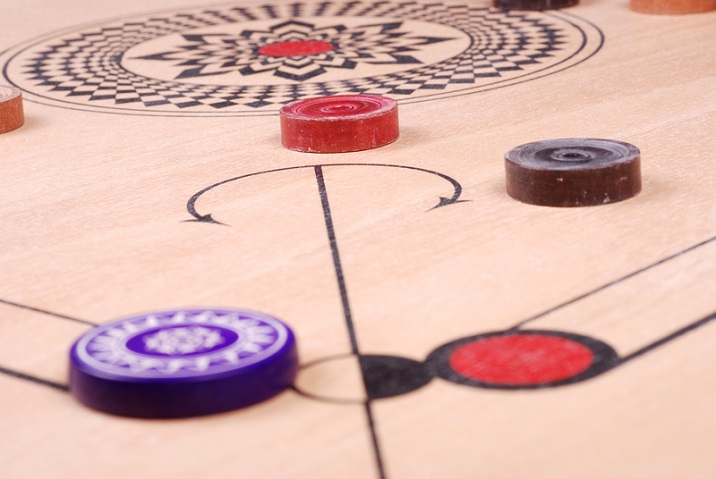
The carrom men


Credit


Like the discs of carrom, we friends too, are
gathered in a circle here, every day;
at the first strike we too are scattered far,
and some fall, while some remain to play.
Sometimes the game is close and passions swift,
and the player might miss a couple of men,
the queen plays hard to get, or drops a gift,
but the one who wins her loses her again.
It’s all shatter and change at every strike
in carrom as in life, it’s just the same
you’ve got to play it, like it or dislike,
you take the board you get in either game.


A few days back, I saw an image of four men playing carrom, not this image, a different one - one to which I have no rights and can't digitally sneak in here :) But being rubbish at digital sneaking does not stop me from drawing word-images in my head. Incidentally, the discs are technically called 'carrom men' - which is what sparked off the whole thing. 

Carrom always reminds me of long afternoons and evenings with my mum, playing various board and card games. By the time this posts, I'll hopefully be on my way to her, but there won't be any carrom played when I get there. No games left in that house. But the parental home is always the parental home, carromful or carromless...right? 

Because I'll be travelling off and on next few weeks, it might take me a bit of time to scramble back online, but I'll get here whenever I can. 

Meanwhile, stay well and keep your game on and lively! :) 


Sunday, 3 June 2018

Empty Nester Countdown


There’ll be no live music, no broken strings.
Every light switched off at bedtime, nothing
left on, no nightly raids, no sudden noise,
no extra-late breakfast weekend mornings.

No sprawl of papers and text books, no trails
of missing laces, no urgent emails
on deadlines and sudden requests to pick up,
no fridge surface cluttered with school details.

How clean will the rooms get?! how organised
the cushions on the sofa, harmonised
dining chairs singing as a perfect choir
flush against the table, neat, civilised.

But a bit more lifeless this life, more sterile
without your hands around it, without your smile.


I have been immersed in post-18 pathway possibilities lately. Less than one year to go before I become mum-of-grown-up-child, yay! n yikes! And a sliver more than a year before the fledgling flies...

In more uniformly cheery news, the sign ups at Write...Edit...Publish... are now open for the June Challenge. Sign up now and post on 20th on Unravelled Yarns...Click the link for details.