Monday, 21 April 2025

R is for... Ripples ... n ... Red Carpet


All this month I am writing about the richness of Indian handlooms, a quick but captivating dive into the saree specifically, a garment worn by Indians for five millennia. Come with me into the magnificent, complex and utterly fascinating world of fibre and yarn, of skills and techniques of dyeing and printing and embroidery, traditions unchanged for centuries. Of sumptuous finished fabrics that not only make a fashion statement, but also constitute our cultural heritage and political identity.


R is for Role


Image credit 
Shabana is wearing a Kanchipuram silk, Smita is in a Odisha Bichitrapuri ikat.
Both were towering actors of the Parallel cinema movement in India in the 70s/
80s. Smita unfortunately passed away shockingly early in 1986 due to post natal
complications, Shabana has gone on to give over 160 films and is still performing.
She is also an activist for women's rights and other disadvantaged groups. Both 
actors shaped the film and fashion sense of their niche audience.


Indian cinema, Bollywood and regional both, have had a huge impact on fashion generally, and sarees specifically, long before celebrity culture became ubiquitous due to social media. Today I'm going to cast a look back and explore the role Indian films and film stars have played, on and off-screen, on the fortunes of the saree. 


Before we get into the details of celebrity fashion, just a few dates to pin the context in place - the first Bollywood film was made in 1913, the first 'talkie' in 1931 and the first colour film in 1937, that's when the costume designs would have really taken off. However, films continued to be made in black and white well into the 60s, the last b/w film was produced sometime in the mid-late 60s. 


In the 50-60s, Suchitra Sen had risen to stardom in Bengali regional cinema, she was called 'Mahanayika' (lit Great Actress) and her fashion choices influenced a generation of Bengali women including my mother and aunts. She was a trendsetter in sleeveless/short sleeved and lace blouses with varied necklines which were copied avidly by her huge fan following. 


In Bollywood meanwhile,  actors such as Sharmila Tagore (from the same family as Jnanadanandini Tagore!), Waheeda Rahman, Mumtaz and Mala Sinha made ripples in the fashion world. A huge craze was created with a new drape showcased in a song sequence from Brahmachari (1968), given below. This particular style became famous as the "Mumtaz saree." 


During the 60s and 70s, sarees were markers of stereotypical characterisation - a virtuous Indian mother, sister, wife/fiancée wore sarees while the vamp wore western/bolder clothes equated with permissiveness.  However, many of the sarees the heroines were dressed in were mill-made printed voiles, polyester chiffons and georgettes. They replaced the hand made ones with mass produced copies of Bandhni and Ikat style handlooms. Successful female actors (e.g. Parveen Babi) endorsed/modelled mill made sarees and wore them in their film roles in the 70-80s (e.g. Vidya Sinha in Chhoti Si Baat, 1976).   


Sridevi, the first female superstar of Bollywood, came to Hindi cinema already a veteran of South Indian films, and rose to stardom in the late 80s. Watch her in this song and dance sequence from the 1989 hit Chaandni below - she wore sarees in many of her most memorable roles/scenes, particularly chiffons, another iconic look from her was in Mr India (1987) in a plain blue one. It's said that she single-handedly upped the demand for chiffon sarees manifold during the last of the 1990s. Read about her fashion influence here.  However, she favoured Kanchipuram silks and other heritage weaves in her personal wardrobe, as did Rekha, another legendary Bollywood diva.


Image credit. Sridevi at the premiere of English Vinglish at the
Toronto International Film Festival.

As the 90s faded and a new millennium started, Bollywood costumes gradually swung away from traditional Indian sarees, swamped by the ever rising tide of globalisation. The younger generation of actresses wore athleisure and more casual western fashions along with a smattering of sarees when required, e.g. the courtroom scene in Aitraz (2004) or Deepika's character in Chennai Express (2013). 


At around the same time the phenomenon that is social media made it possible 

1) for particular scenes/songs and costumes go viral within hours of the release such as the blue saree of Deepika Padukone in Yeh Jawani Hai Deewani (2013) and the 'string' aanchal of Kareena in Heroine for example. 
2) the 24/7 fan access to strictly curated, PR-managed star personas and private lives. 


In the early 2000s, the then leading lady of Bollywood, Aishwarya Rai became the brand ambassador for L'Oréal, she was already an ambassador for Longines by then. Time magazine included her in their list of 100 most influential people in 2004. The glam quotient of Indian stars which was already pretty robust at home soared into the stratosphere. Subsequently several others - Deepika Padukone (Louis Vuitton, L'Oréal, Adidas), Priyanka Chopra Jonas (Bvlgari, Cartier), Sonam Kapoor (Dior), Alia Bhatt (Gucci) Ananya Pandey (Swarovski, Chanel) - have become brand ambassadors. 


Many Bollywood stars have appeared in designer saris on the red carpet at various international events (Cannes, Met Gala) as also in heritage weaves for award functions or other cultural activities. Meanwhile, international celebrities have also showcased sari inspired fashion on the global stage from the early years of the 21st century. 


Image credit 
Naomi Campbell at the 2023 Met Gala in
a sari inspired Chanel archival number.


Read more about the impact of Bollywood stars and other celebrities on our handloom heritage here and here. 


One of the spin-offs of stars being on social media has been the vicarious consumption of Indian celebrity weddings. Till recently, actors kept their weddings under wraps as single stars were considered to have a more 'marketable' image for the usual Bollywood romantic formula fare. But that has been ditched in these last decades - curated wedding photos of Priyanka Chopra Jonas, Anushka Sharma, Deepika Padukone - Ranvir Singh, Alia Bhatt - Ranveer Kapoor, Katrina Kaif, Sonakshi Sinha among others, have been available on social media almost instantaneously after the ceremonies. 


It may be questionable taste to turn a greatly significant private milestone into a gaudy social media spectacle, but it does focus public attention on the textiles. Celebrity bridal attire has trended on a viral scale, usually consisting of designer handwoven and/or hand embroidered fabrics. This has promoted knowledge and awareness of our heritage weaves like Bandhni, Benarasi and Kanchipuram. 


YouTube and Instagram influencers, as well as fashion analysts, have recreated star looks based on cheaper imitations. A whole new trend of pastel toned/ivory bridalwear has taken off based on some celebrities ditching the traditional Indian bridal red. A whole new industry too - that of wedding planning and event management, has taken shape.


Of course celebrity attire remains way beyond the means of most of their fans. So how much of actionable impact this has had for ordinary women beyond just aspirational value remains to be seen. Whether star power can reverse the slow erosion of skills and rev up the demand for handlooms is still unclear. 


~~~


What do you think about stars promoting/wearing sarees, do you think it helps the cause of handlooms? 


Thank you for reading. And happy A-Zing to you for the rest of the challenge if you are participating. 


A-Z Challenge 2025 

Saturday, 19 April 2025

Q is for ...Quagmire ... n ... Quail, definitely


All this month I am writing about quintessential Indian handlooms, a quick but captivating dive into the saree specifically, a garment worn by Indians for five millennia. Come with me into the magnificent, complex and utterly fascinating world of fibre and yarn, of skills and techniques of dyeing and printing and embroidery, traditions unchanged for centuries. Of sumptuous finished fabrics that not only make a fashion statement, but also constitute our cultural heritage and political identity.


Q is for ...


...a fearsome quagmire that makes me quail. Every year...without fail. But I am super lucky that I can yell for help from my third home that once was, for a quick fix. 


So. Q is for Qutn...which you will immediately recognise for what it is, the Arabic word which gave the most widely used natural fibre its name - cotton. The very heart of Indian handlooms, exported for centuries from antiquity. 


The history of cotton use is deep and rich, though its exact origins are still shrouded in mystery. It is thought that cotton was discovered independently in different places. Cotton has been known for millennia - the earliest archeological evidence has been found in ancient civilisations in Asia, Africa and South America. 


Image credit. Earliest evidence of cotton cultivation in the ancient
world. Dates in years BP. 


In the Indian sub-continent, evidence of cotton textiles have been found at Mehrgarh, a Neolithic site predating the Indus Valley Civilisation. And we've already seen that something akin to Ajrakh pattern textiles were in use in Mohenjo-Daro four thousand years ago. Excavations there have revealed dye vats with woven fragments of madder-dyed cotton indicating knowledge of weaving of fabrics and dyeing techniques.  


The cultivation of cotton started in the Indus Valley Civilisation (of which Mohenjo-Daro is a part) by 3000 BCE. Cotton is mentioned in the Rig Veda, those hymns being written in Sanskrit in roughly 1500 BCE, the oldest religious/literary compositions known to us. The Sanskrit words for cotton 'karpas' and 'karpasum' travelled west into Latin as 'carbasus.' So it can be safely inferred that cotton was known and grown in India deep in antiquity, and the trade in it became so developed that it became as inextricably associated with India as silk was with China.  


Famous Greeks have mentioned Indian cotton - Herodotus wrote about Indian cloth as 'the wool exceeding in beauty and goodness than that of sheep' in 5th century BCE. Strabo too wrote about the vibrance of Indian textiles.  Arrian mentions the trade in Indian cottons in 130 BCE.


The Book of Esther (written 4th-2nd century BCE) has a reference to blue and white striped cotton hangings in the royal palaces of King Ahasuerus (widely believed to be Xerxes I by historians) -  further evidence of the cotton trade with the Persian Empire. Read more about that here.


Chinese travellers to India - Faxien in the 5th century, Xuanzang a couple centuries later, both mentioned Indian cotton and weaving hubs that they encountered in their travels.  European explorers who came east such as Marco Polo and Vasco da Gama also record the vividness and superiority of Indian fabrics. In sum, there is no shortage of sources who confirm the excellence of Indian handloom cottons from the earliest times to the 18th century. 


The spinning wheel or charkha came into use in India sometime between 13th/14th century and it is still used at present to produce handspun handwoven premium sarees. We have seen earlier how the charkha was used in India's freedom struggle and represented self rule/self reliance. The diffusion of the charkha through out the sub-continent increased yarn production and therefore boosted the textile output also.


During the Mughal period (1526-1857) cotton cultivation and the Indian textile industry boomed. The third Mughal Emperor, Akbar the Great (1566-1605), introduced a series of agrarian reforms and replaced the tribute system with a new tax regime called zabt, based on a uniform monetary currency. The state funded irrigation systems that increased crop yields and therefore the tax base. 


The system favoured cash crops and therefore cotton as well as indigo were given a fillip. By the time the Portuguese, followed by the Dutch, French, Danish and finally the British landed up, the Mughal Golden Age was at its height. When Jehangir, Akbar's son, granted the first permit to the East India Company to set up a permanent factory in Surat in 1613, India had an estimated 25% of the global GDP. The Bengal Subah (province) itself contributed around 12%, cotton textiles being a significant export. 


(Indian chintz)…crept into our houses, our closets, and bed-chambers; curtains, cushions, chairs, and, at last, beds themselves were nothing but calicos or Indian stuffs… almost everything that used to be made of wool or silk, relating either to the dress of women or furniture of our houses, was supplied by the Indian trade…

~ Daniel Defoe, in The Review, 1708.


Industrialisation paired with the discriminatory policies of the British Raj brought to an end the Indian supremacy in cotton textile exports in the 18th-19th century. Many skills were lost and several types of sarees disappeared such as the 'woven winds' Muslin and the Baluchari.


The Treaty of Allahabad. Signed in 1765 between Mughal 
Emperor  Shah Alam II and Lord Robert Clive of the East 
India Company. This treaty granted EIC the right to act on 
behalf of the Mughal state, & changed the Indian economy 
in fundamental ways forever. 
Exhibit in the Reserve Bank of India Museum.


As discontent boiled over and the struggle for self determination intensified, the coarse handspun handloom cotton was weaponised as a tool for political resistance and as a symbol of self rule. 


The Indian textile industry was built up again after independence was achieved in 1947. The Baluchari for instance was revived and woven on jacquard looms from the mid-20th century. And Bangladesh has revived the Dhaka Muslin in 2022. It has also clawed back the second largest share of global textile exports (8%)  after China (31%) in 2021 and has retained that position since. 


India's performance is not as stellar but remains strong, it is among the top 10 textile exporters globally with a current share of around 4%. India is also the second largest producer of cotton and has around 17% of the world production. 


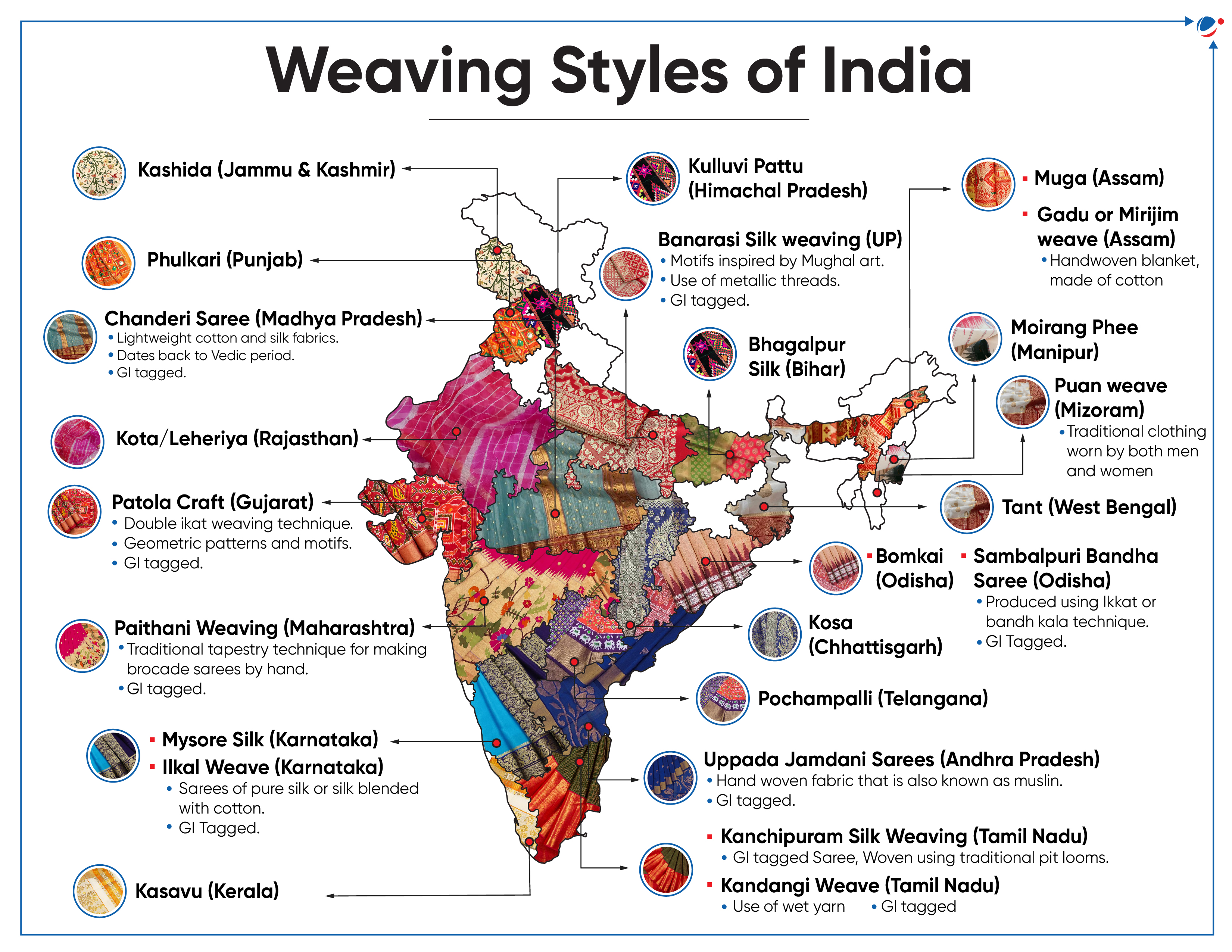
Image credit Map of India giving the main weaving states
and the handlooms they produce.


~~~


Did you know that the current percentage share of cotton is 24% in all yarns? Now that's less than a quarter of all fibres used globally. Polyester surpassed cotton in 2002 to become the most widely used material. However, for nearly 7000 years cotton was the primary material used in garments. 


Thank you for reading. And happy A-Zing to you if you are participating in the challenge. 


A-Z Challenge 2025 

Friday, 18 April 2025

P is for ... Phenomenal ... n ... Perfect


All this month I am writing about the phenomenal Indian handlooms, a quick but captivating dive into the saree specifically, a garment worn by Indians for five millennia. Come with me into the magnificent, complex and utterly fascinating world of fibre and yarn, of skills and techniques of dyeing and printing and embroidery, traditions unchanged for centuries. Of sumptuous finished fabrics that not only make a fashion statement, but also constitute our cultural heritage and political identity.


P is for Patan Patola


Going to start off today with this video on the Patan Patola saree, the most expensive double ikat silk saree that can take up to a year to create and can cost thousands of US dollars. The process from start to finish, to get that pattern perfect on the loom, is beyond mind blowing.  No words! 


There are also the Paithani and the Pochampally, associated previously with royalty and/or luxury, as most silk sarees were in the past, and to be perfectly honest, still are. 


P is for Princess and Purdah 


We've seen in a previous post how the Nivi drape was modified and modernised with the pairing of blouses and petticoats, directly inspired by Victorian England, pioneered by Jnanadanandini Tagore during the last decades of the 19th century. 

Image credit.


Another lady who played a prominent role in popularising the saree was Maharani Indira Devi of the princely state of Cooch Behar. She was one feisty, progressive character, a princess from Baroda, she broke off her engagement with a Maharaja of 21-gun-salute Central Indian princely state, and married for love a younger prince of a much less important kingdom, Cooch Behar in Bengal, who she'd met at the Delhi Durbar in 1911. Her parents were vehemently opposed to the match, it created a massive scandal given the social conventions of the time, but she persisted. The marriage was solemnised according to Brahmo Samaj rites in London. 

However, both her brother-in-law the king and her husband passed away early and she ended up having to act as regent for her minor son. She travelled widely in Europe and it was during a trip to Lyon that she came upon French chiffon. The delicate texture of the fabric bowled her over. So she ordered a nine yard chiffon saree in white, not exactly the traditional Indian mourning attire for widows. She introduced chiffon sarees to Indian women and got her sarees woven on those French looms, pairing them with diamond encrusted footwear and strings of pearls. And chiffon sarees with pearls are still a matchless pairing in the Indian fashion lexicon. Vogue featured her in the 1960s for her enduring legacy. One of the first ladies to challenge patriarchal norms. 

Incidentally, this increased participation of upper class women in public life, advocating for women's education and equal rights, led to the abolishment of the purdah system (seclusion of women). Indira's mother Chimnabai had appeared without veiling in Baroda, so did Lady Meherbai Tata, wife of Sir Dorabji Tata, a notable philanthropist and an industrialist knighted by the British Raj.   

Btw, chiffon is defined by a particular yarn type, just like georgette. It is produced by using a high twist crepe yarn in a plain weave and gives a sheer, lightweight, lustrous fabric. It can be made with natural of synthetic fibres. Indira got her chiffons made in real silk, so their price tag must have been one only a maharani could afford. From 1930s/40s onwards, man made fibres like polyester, viscose and nylon made chiffon fabrics affordable for the vast majority of people. 


~~~


Did you know that  - not everything is positive in the sareesphere? It is sometimes used as a tool of patriarchal control, imposed on women as a dress code in specific professions and/or situations. Read about one Sri Lankan woman's experience here.


Thank you for reading. And happy A-Zing to you if you are participating in the challenge. 


A-Z Challenge 2025 

Thursday, 17 April 2025

O is for ... Original ... n ... Ordinary


All this month I am writing about outstanding Indian handlooms, a quick but captivating dive into the saree specifically, a garment worn by Indians for five millennia. Come with me into the magnificent, complex and utterly fascinating world of fibre and yarn, of skills and techniques of dyeing and printing and embroidery, traditions unchanged for centuries. Of sumptuous finished fabrics that not only make a fashion statement, but also constitute our cultural heritage and political identity.


O is for Old-timers 


Today I want to tell you about my own experience - of wearing sarees myself, of seeing my female ancestors wear them and how the draping style changed over generations in my family. The Bengali 'aatpoure' (aahT-poh-oo-ray meaning all-day all-time, ordinary, constant-use) drape is very different from the Nivi drape in that it is not gathered into pleats, it is wrapped around the lower torso once to the left and once to the right, so that there are three thicknesses around the lower body and the aanchal is wrapped around the upper body twice.  Watch this well known drape artist do an authentic Bengali aatpoure drape in the video below.


The oldest person I've seen wearing a saree was my great grandmother, my mother's grandmother. She was likely born in the late 1880s or early 1890s, just a couple of decades after Jnanadanandini Tagore had modernised the ordinary Bengali drape and a time of great social change for Bengali women. But clearly the style had not reached my great grandma. Not everybody was a fan of the fashion forward Bengal Renaissance  style progressiveness. 


By the time I met my great grandmother, she was a widow. She wore the stark white borderless unembellished saree that Bengali widows of her generation were expected to wear,  without any undergarments or blouses, draped in the original Bengali aatpoure style. I visited her several times with my mother and her outfit did not differ in a single detail - always white, always borderless, not a spot of colour anywhere on her person. Incidentally, she did not wear any jewellery either and her hair had been cropped close as a marker of widowhood. There were strict food taboos as well, no fish/meat, no eggs, no onions and garlic, a circumscribed vegetarian diet. She lived alone with a helper/companion, also a widow, so I assume the dress, hair and diet were voluntary - she probably felt compelled to follow societal norms of her times, which were particularly unkind to widows. 


My paternal grandmother and great aunt in the sixties.
Both ladies are wearing the aatpoure drape. Note the 
double layer of the aanchal/pallu. The inner layer is used 
to cover the head. Bengali ladies of their time did not 
appear in public with their hair uncovered. 


My grandmothers and great aunts never wore anything else apart from sarees. Neither did my mother, except in old age when she was too infirm to dress herself. My grandmothers wore the aatpoure drape inside their homes and even when they stepped out occasionally. My mother I've never seen wearing the ordinary drape at all, she always wore the Nivi style saree. All ladies wore an undergarment around which the saree was draped and which held the saree in place.  


My great aunt wore a long 'chemise' which combined the blouse and the underskirt into one, an Indian modification of the French chemise a la reine, a style of garment first worn by Marie Antoinette in the 18th century.  Incidentally, the French had established a trading post in Chandannagar about 50-ish kms from Calcutta in the 1670s which remained under French control till 1952. So it's not surprising that French items of apparel found their way into Bengali fashions, especially since the Queen's original garment was made out of Bengal muslin!  Not that my great aunt wore chemises of highly expensive muslin, hers were made in plain cotton fabric. My grandmother on the other hand, wore a separate jama (blouse) and a shaya (petticoat), more in line with the Victorian dress format.


I remember my grandmother in white sarees with red borders (she predeceased my grandfather, so there were no taboos on borders or their colours). My great aunt was a widow for the entire time I knew her so I've seen her always in a narrow, black-bordered white saree, an inchi paaR, or a one-inch bordered saree. Most Bengali women of my grandmother's generation transitioned to white sarees when their children got to adulthood. My mother followed the same convention - as I reached my twenties, she phased out the colours in her wardrobe gradually to white based sarees, at first with small butis (motifs) or thin stripes in colour on a white body, then to a completely white-bodied saree with broad, coloured borders. Like my grandmother, my mother too predeceased my father, so she wore all colours in her borders. 


Red is a marker of marriage in India, an auspicious colour - so a widow of my mother's time wearing red would be frowned upon. Conversely, it is the norm for Bengali married women to wear bright red bordered sarees on religious/festive occasions.  In short, a saree wasn't just an outfit in the last century,  it signalled a woman's marital status and her age to the society at large. 


Incidentally, my mother has been the overriding influence in my saree wardrobe and my obsession with handlooms. She wore handloom sarees exclusively all through her life and did not switch to any other mode of dress even while she lived in Nigeria or travelled around Europe on holidays. As a child, I never saw her wear any factory/mill made, mass produced saree, she was always in handloom cottons, the plainer weaves for everyday wear, the fancier ones kept for going out. And a few silk handlooms for grand occasions. She was  born in pre-independent India, both my parents were, and she started wearing sarees in the 1950s in newly independent India when the call to champion the cause of indigenous artisans was strong and unambiguous, the wearing of Indian handmade textiles a pathway to revive the proud Indian heritage lost to colonialism and one small step towards rebuilding the nation. 


My aunts too, her sisters and sisters-in-law, wore sarees exclusively and Bengal handlooms most of the time. Some of them might have worn mill made ones for convenience occasionally, e.g. in the rainy season, when handlooms are difficult to dry and starch. In short, ladies I saw all around me growing up reinforced the same preferences for Indian handlooms. 


The youngest of my paternal aunts was widowed when she was less than 30. She did not follow the societal taboos imposed on widows about diet, jewellery etc, but she did stop wearing coloured sarees. She wore white and never wore a red bordered one again. The customs of centuries run deep even when we all know that they are unfair. In my own generation, widows no longer give up anything that they don't choose to, thankfully. However, I do believe this is limited to urban, educated Bengali women only. In the villages, prejudices against widows are probably still rampant. 


So, that's the sum of my own experiences observing the sarees I've seen worn around me. The older generations wore the aatpoure drape both in and out of the home, some without blouses and underskirts but most with them. Women in my family born 1920s onwards wore the Nivi drape almost exclusively and never wore the aatpoure style. 


I learnt to wear a saree around 11/12 years of age, once I got to secondary school. I've also worn the Nivi drape almost exclusively, except a  handful of occasions where I wore the seedha-palla (the aanchal on the right shoulder brought from back to front). I know how to do an aatpoure drape but I have never worn that version.  I think I need to try it out once! - now that it's become quite trendy to drape sarees in new styles. The aatpoure drape has made a comeback lately and many of the younger generation are wearing it, especially for festive occasions and weddings.


In a seedha-palla Benarasi. My aunt is behind me in a
Nivi drape Bengal handloom. Also among the ladies
who influenced my wardrobe preferences.


~~~


Did you know that India is not the only country where the saree is worn? Women in other Asian countries wear sarees too - in Pakistan, Bangladesh, Nepal and Sri Lanka. Sinhalese women wear the saree in Sri Lanka where it is called the Osariya style. Read more here. 


Thank you for reading. And happy A-Zing to you if you are participating in the challenge. 


A-Z Challenge 2025 

Wednesday, 16 April 2025

N is for... Nine ... n ... Nudity


All this month I am writing about the marvellous Indian handlooms, a quick but captivating dive into the saree specifically, a garment worn by Indians for five millennia. Come with me into the magnificent, complex and utterly fascinating world of fibre and yarn, of skills and techniques of dyeing and printing and embroidery, traditions unchanged for centuries. Of sumptuous finished fabrics that not only make a fashion statement, but also constitute our cultural heritage and political identity.


N is for Nauvari


Image credit. The location of Maharashtra within India.

Your average, normal saree is roughly 5.5-6 m (6 yards) long. The Nauvari is a special saree worn by Maharashtrian women. Nine yards in length, it's worn in such a way that its ends are taken between the legs and tucked in at the back resulting in a trouser like drape, with much greater freedom of movement. Very similar to the dhoti, incidentally. The Nauvari is also known as the Kaashta saree and the Sakachha. 


Watch a Bollywood musical sequence below, an 18th century period drama featuring two mega celebrities wearing the Nauvari. Note how it combines tradition, elegance and shows off every nuance of the footwork. And read about the development of the Sakachha from the earliest times in this article. 


From what I can make out, the Nauvari, as it is worn today, originated during the Maratha Empire under the Peshwas in the 18th  century, so it has a 300 year old history even if we discount the 'sakachha' styles of the Gupta period (320-550 CE). 

When you consider that  -

1) the Maratha Empire started off as a rebelion against the Muslim Sultanates of the Deccan region 

2) was characterised by guerrilla tactics 

3) the army was drawn from peasant pastoralists 

4) several women of the ruling elite actively participated in empire building,

the introduction of the Nauvari feels logical under the circumstances. The style of draping allowed women to be combat ready, to defend or escape, to ride horseback without hindrance, as also perform their daily tasks with greater freedom. In short, it was developed by women living with the practicalities of a state at war. With time, it has evolved and differentiated into minor variations worn by different groups/regions within Maharashtra. Read about the present day Nauvari here and here.


...also for Nivi


The Nivi drape is the most common way to wear the saree - with the free end thrown over the left shoulder and a series of pleats tucked in at mid-waist level. This draping style is  actually a modern take on the saree, though it has become so ubiquitously pan-Indian that most people when they think of a saree think of the Nivi drape. It's the way most women wear the standard 6 yard saree in India.


There are in reality many dozens of ways to drape a saree, several regional variations -  Nauvari being one of them, as we have just seen. Originally the Nivi style was draped in the Deccan, in Andhra as a regional style. Read more about the regional draping styles here. 


The modern Nivi drape was devised by a Bengali lady, Jnanadanandini Devi Tagore (1850-1941), the sister-in-law of the famous Nobel Laureate Rabindranath Tagore - she was married to his eldest brother Satyendranath, the first Indian to join the Imperial Civil Service. Jnanadanandini was a leading social reformer, a champion of women's emancipation and a fashion icon of her time. 


Image credit
L to R : Jnanadanandini, Satyendranath, Kadambari.
Seated: Jyotirindranath Tagore.
 

At the time, most Bengali women wore sarees without undergarments or blouses in the 'aatpoure' style. It served most women well as they led a cloistered life inside the home in the women's quarters. 


Image credit

To understand the exact social context - the First War of Independence had happened in 1857, following which the Crown took over from the East India Company in 1858, the start of the British Raj. Victorian notions of morality and modesty met and inevitably clashed with Indian body positivity and confidence as displayed in easy-breezy bare bodied saree draping. Nudity was equated with backwardness by the Brits.  The social reformers and opinion leaders of the era therefore undertook to dress women more 'appropriately,' in keeping with Victorian ideals of propriety. Bare bodied saree drapes were no longer perceived as adequately 'civilised.'


Jnanadanandini was reportedly refused entry somewhere in Bombay by the Raj, because she wore the saree over her bare upper body. She had met Parsi women who wore the saree with jacket style blouses, an underskirt and central pleats tucked into the latter. The aanchal/pallu was brought over the right shoulder and tucked at the left covering the upper half of the body. Jnanadanandini therefore adopted this style with minor tweaks. She changed the aanchal placement to the left shoulder so as to leave the right arm/hand free for greeting/work and created this new style. This was initially called the Brahmika saree and changed to Nivi over time, not quite sure exactly when. She also wrote articles and took out advertisements in a women's magazine called Bamabodhini to educate women and popularise the new drape.


The late 1800s was also a time of an avalanche of changes for Indian women, they transitioned from rarely seen homebodies to active participants in various public spaces. The first women's college in India was established in Calcutta in 1879, the first time women students were granted admission to medical colleges was in the 1880s. As women got educated, graduated universities and became the first female professionals, they needed a new, modern dress code which the Nivi style met admirably well. By the early 1900s the Nivi had become widespread, especially among the younger women. 


...and the Navel


If you look at the earliest sculptures and other archeological evidence of saree in India, you'll find the midriff and more particularly the navel was mostly bared and women were not secluded and did not veil their heads/faces. These practices came later on and were further reinforced with Islamic influences, they modified the style in which sarees were worn - less skin shows. 

There is a deep seated cultural reason for the navel to be exposed, less about sex appeal and more about spirituality. The ancient Indians believed the navel was the conduit of spiritual nourishment even after the umbilical cord was cut. The navel's job was to seek energy from the environment and channel it into the body therefore it was recommended that it be left bare, especially in sunlight. 


The navel is bared. Bronze sculptures
from the Chola kingdom, around
1000 CE. British Museum.

Nowadays, there is no hard and fast rule, it's a personal choice  how much of the midriff is exposed and if the navel is bared or not.

~~~


Did you know that sarees are draped in numerous different styles? Every region has its own particular way in which the saree is draped - pleated in the front, pleated at the back, not pleated at all, the free end or aanchal/pallu thrown over the left shoulder, right shoulder, down the back or at the front, endless permutations are possible because it's a piece of unstitched cloth!


Thank you for reading. And happy A-Zing to you if you are participating in the challenge. 


A-Z Challenge 2025 

Tuesday, 15 April 2025

M is for ... Marvel ... n ... Many


All this month I am writing about the marvellous Indian handlooms, a quick but captivating dive into the saree specifically, a garment worn by Indians for five millennia. Come with me into the magnificent, complex and utterly fascinating world of fibre and yarn, of skills and techniques of dyeing and printing and embroidery, traditions unchanged for centuries. Of sumptuous finished fabrics that not only make a fashion statement, but also constitute our cultural heritage and political identity.


M is for Myriad Motifs


We could talk about many sarees here - the Maheshwari, Mangalgiri, Moirang Phee, or materials like Matka and Muga silk, or Mashru - the list is endless. Couldn't make up my mind!  So I'm going to talk about the motifs in Indian sarees instead. They too number a million, so this is by no means exhaustive. 


Bear in mind that India is a diverse nation - 22 officially recognised language groups spread over 28 states and 8 union territories, each with their own micro-environments. A dozen or so faiths/systems of spiritual beliefs, landscapes ranging from tranquil, flat coastal to deep tropical forests to snowy Himalayan to arid desert and everything in between. Now add to that a layered history of migration, trade and cultural exchange through five millennia and you get a melting pot influencing the design vocabulary of the saree. We have already seen in an earlier post how the Ganga-Jamuna border design element has diffused into regions where neither of the two rivers are present. 


Many of the motifs draw inspiration from Indian mythology, local temple architecture, flora and fauna and natural elements. As mentioned before, the Mughals meshed design concepts from their original Persian motherland with Indian traditions, Mughal and Islamic aesthetics have moulded the textile industry in a major way. Indian handlooms have a wide range of motifs combining the most ancient with these medieval influences. Of course, design is not static, the  current generations of textile designers draw upon the traditional to devise modern ones, so that the design pool is always evolving and expanding.


Here are some major design motifs used in sarees. I'm using English as the names of the motifs vary across India among different language groups. Mayur in Bengali becomes Mor in Hindi and Mayil in Tamil, they all mean the same thing. 


Animal motifs - Lion, Tiger, Deer, Cow, Elephant etc. Each one symbolises a unique quality and significance. The deer for example  embodies grace and gentleness. Includes mythical animals like the Winged Horse.

Birds - Traditional ones are the Peacock, Peacock 'eye,' Swan (Hamsa/Hans), Parrot, Cuckoo 'eye', Cranes. Also include mythical ones like the two headed Eagle.  Modern motifs like the Flamingo are seen in Batik sarees. 

Chariot - a wooden vehicle on which deities are placed are drawn, of special significance in Hindusim. Lord Krishna was the charioteer of Arjun in Mahabharat, an important epic.

Conch - connected to Hindu mythology and blown at religious rituals. A signifier of auspiciousness.

Coconut - often on a pot called the Kalash or Kumbha. Another item used in prayer/rituals and considered auspicious.

Fish - motif popular in the East. Fish is considered auspicious as in Indian mythology, Vishnu came to the Earth as a giant fish to save Manu (the first man) and the Vedas from a great deluge.

Flowers - can be individual or clusters. Called the 'buti' if small and 'buta' if large. Many are depicted, of special importance are the jasmine, rose, marigold, tulip, crocus, iris, narcissus, and the champaka. Flowers are offered to deities in temples and private shrines, they are symbols of beauty and grace. Several were introduced from foreign lands and included in the Indian repertoire. Floral motifs were expanded under the Mughal rulers as Islam frowns upon the depiction of figures. They are used extensively in Benarasi sarees. Read more about flower motifs here.

Geometric - various types of geometric motifs, stripes, checks and pattern repeats may be used, especially in the aanchal and borders.


A combination of floral and geometric motifs in this
cotton handloom from Bengal. Note the small flower/
leaf  'buti' in the body of the saree.


Lotus - this flower deserves a separate discussion. The lotus is a recurrent motif across India because it has a special significance in Hinduism. It grows in mud but is untouched by it, symbolising purity, creation and detachment from the material world. Deities are often depicted seated on the lotus or carrying one. The lotus motif in sarees can be an 8 petalled  or a 100 petalled one. Viewed from above or in profile. Read more about the Lotus in textiles here.


Image source Lotus motif in ikat


Hunting scene or Shikargah - the hunter, elephant, deer, lion/tiger depicted among trees/forest without any actual violence taking place. A tranquil celebration of animals and humans. Read more about the motif here. 

Leaf - The heart shaped leaf Sacred Fig (Peepul/Ashwatha) tree is revered as Buddha attained enlightenment under one and is represented on sarees and other textiles. The Tamarind leaf is also a motif used in sarees. 

Mango - a greatly popular motif across India - the mango is symbolic of fertility and auspiciousness. The fruit is depicted on all kinds of textiles, shaped similar to the next one.

Paisley - a more elaborate flower or flowering vine in a teardrop shape, the tip of the drop drooping slightly. Or a vase with a bouquet of flowers. The paisley started off in India in Kashmiri weaving and embroidery, especially in their luxurious pashmina shawls. Originating in Persia, it was called boteh or buta here. These shawls carrying the characteristic motifs became extremely popular in the West. With the invention of the Jacquard looms in the 19th century, cheaper imitations of the Kashmiri patterns were woven in Paisley in Scotland, and so the motif came to take on the name of the town. 

Rudraksha - the dried fruit of the Rudraksha tree, held to auspicious. 'Rudraksha' is believed to have originated from Lord Shiva's tears. Rudra is a name for Shiva, aksha means eye. Often used as a talisman. 


Rudraksha motifs on a Kanchipuram silk. 


Rudraksha motifs on a Sambalpuri silk from Odisha.


Temple  - rows of triangular motifs running along the border of sarees - especially Kanchipuram sarees, are called Temple border sarees. Inspired by the 'gopurams' or the ornate gateways to South Indian temples. Also seen in sarees from elsewhere,  such as Odisha and Vidarbha.  

Tree of life - a symbol of growth, abundance, fertility and perceived to provide protection. Depicted with fruits, flowers, birds and in full foliage depicted in a stylised version, not any particular botanical species. 

Read more about sarees motifs here, here  and here. 


~~~


Did you know that mirror work, sewing in small pieces of mirror, into a fabric, originated in Persia and was brought to India in Mughal times? It was adapted into the local repertoire particularly in the Western Indian states of Rajasthan and Gujarat where it became a characteristic style. 


Thank you for reading. And happy A-Zing to you if you are participating in the challenge. 


A-Z Challenge 2025