Showing posts with label A-Z Challenge 2025. Show all posts

Monday, 28 April 2025

X is for ...Xrikey!! ... n ...Xood Xrief!! ... n... general Xemesis!!


All this month I am writing about Xquisite Indian handlooms, a quick but captivating dive into the saree specifically, a garment worn by Indians for five millennia. Come with me into the magnificent, complex and utterly fascinating world of fibre and yarn, of skills and techniques of dyeing and printing and embroidery, traditions unchanged for centuries. Of sumptuous finished fabrics that not only make a fashion statement, but also constitute our cultural heritage and political identity.


Spot the X

I'm going to Xtricate myself from the ghastly predicament that is X by clutching at whatever straws I can find with a mishmash of factoids and images. So here goes.


First things first - spot the Xs in these textiles hereunder:


Batik on Bishnupur silk saree.


Floral print on Tussar saree.


Warli block print detail on Tussar saree. The Warli 
are an indigenous tribe from Maharashtra, they 
decorate their mud walls with art using these stylised 
geometric motifs representing nature and humans.  


Look at the negative spaces in the aanchal!
Pochampally single ikat cotton saree.


Rudraksha border  on a silk ikat saree from Odisha.


X is for cultural Xchange


Indian textiles have been traded across the world and have influenced the fashions in Europe, Far East and America from ancient times onwards. However, trade is always a two way process. Over many centuries, Indian textiles themselves have also been cross-pollinated by cultural exchanges through trade and travel. Read about the broad influences of the outside world on Indian textiles here and then, consider the following:

  • There's some evidence that the IVC had knowledge of wild silks, but that was lost when that Civilisation collapsed around 1500 - 1400 BCE. It is widely believed that sericulture (of mulberry silk) was introduced into India from China sometime in the 2nd/1st millennium BCE. 
  • Persian influence on Indian textiles is massive and obvious. From brocade weaving (Benarasi) to textile motifs (buti/buta, shikargah) to actual words used for specific techniques (jamdani, chikankari)  show the myriad ways the Persian Empire impacted Indian textiles.
  • Batik has come to India from Indonesia. In Santiniketan, Rabindranath Tagore brought back Batik pieces and had it introduced through the Arts School or Kala Bhavan of the Bishwa Bharati university he established. It combined there with  Bengal's unique aesthetics and motifs to form a genre of sarees/textiles by itself. 
  • Indian Parsi (Zoroastrian refugees from Iran who fled to India from Iran in the 8th century) traders brought back exquisite, white-on-white embroidered Chinese fabrics in the 19th century, which the Parsi community ladies wore as sarees. This is how the 'Parsee Gara' embroidered saree has Chinese motifs. Due to the high demand for these sarees, a community of Chinese embroiderers came to settle in Gujarat, plied their trade and hawked their wares door-to-door in the affluent neighbourhoods of Bombay and other major cities in India. Read more about the Parsi Gara here and here.
  • Delicate French lace found its way into Indian royal wardrobes in the late 19th/early 20th century as sarees for the royal ladies. By the 1960s/70s (machine-made)  lace sarees were popular enough to be recorded as a trend. Read more about that here. We've already seen how Marie Antoinette's chemise a la reine influenced Bengali ladies fashions. It was adapted to wear with the saree to cover the shoulders and upper body. Along with French lace, French chiffon sarees were also much prized after Indian royal princesses/queens  (remember Indira Devi? of Cooch Behar) and prominent elites wore them. 
  • Incidentally, lace making was brought to India by European missionaries and nuns who came in after Vasco da Gama opened up the sea route to India in 1498. They taught lace making in their convents  to the women who lived in the surroundings, along with other European crochet and embroidery styles. These are collectively known as 'convent embroidery.' There is no systematic record of hand made lace or convent embroidery in India. However, lace edgings on Indian garments such as women's kurtas, dupattas and sarees, as well as saree blouses and petticoats are quite popular. The Bengali word for the petticoat is 'shaya,' derived from the Portuguese 'saiote' - another small mark of the European cultural exchange.
  • Madras Checks are thought to have been influenced by the Scottish plaids in the 1800s after the British set up a trading post in Madras, though the fabrics themselves can be traced back to at least the 13th century. Read more about the Madras checks here. 
  • British influence is of course not restricted to the Madras Checks alone. Victorian sensibilities of the 19th century fundamentally altered the way sarees were worn in India. The blouse and the petticoat were added to Indian women's wardrobes as bare bodied saree draping was not considered decent.


    So there we have it - China, Indonesia, Persia, Portugal, France and finally Britain. I'm sure this is not Xhaustive though, there would be other cultures who've inspired/influenced the Indian textile industry lurking somewhere in the annals of history. But this is all there is time for today and I think it's more than sufficient to be getting along with. Gosh, am I glad that X situation's behind me now!


    ~~~

    Did you know that Xuan Zang, the Chinese monk, wrote about Indian textiles that he encountered in his extensive travels in this country in the 7th century?  He mentions among others, Mathura as a hub of cotton weaving and records that silk was produced and traded in Kamarupa, that is Assam. He also wrote about the habits and customs of the people of the kingdoms he visited, including their faith and modes of dress. Seriously helpful for the historians. And for the A-Z, phew!


    Thank you for reading. And happy A-Zing to you for the end days of the challenge if you are participating. 


    A-Z Challenge 2025 

    Friday, 25 April 2025

    V is for ... Vivid ... n ... Various


    All this month I am writing about vibrant Indian handlooms, a quick but captivating dive into the saree specifically, a garment worn by Indians for five millennia. Come with me into the magnificent, complex and utterly fascinating world of fibre and yarn, of skills and techniques of dyeing and printing and embroidery, traditions unchanged for centuries. Of sumptuous finished fabrics that not only make a fashion statement, but also constitute our cultural heritage and political identity.


    V is for Vegetable 


    Before we get into the main topic, I'd just like to mention Venkatagiri sarees. These are woven in Andhra Pradesh, with a history going back to the 1700s. Read about these sarees here and/or watch a short video about them below:


    There's also the Valkalam saree, but we'll visit that in a later post. It is a saree from the super ancient weaving hub of Benaras or Varanasi, which needs time and a bit of elaboration to do it justice. Can't do that here. 


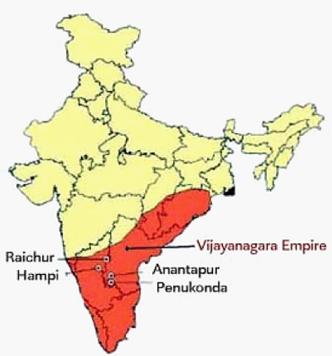
    Incidentally, Vijayanagar was a Hindu Empire that lasted for two centuries (1336-1565) and was an important historical milestone in South India. Though geographically much smaller and of shorter duration than the Mughal Empire in the North, it left a similar cultural legacy in literature, architecture and art of the southern region. It had a roaring trade in textiles, woven in centres like Coimbatore, Mysore and Pulicat.


    Image credit

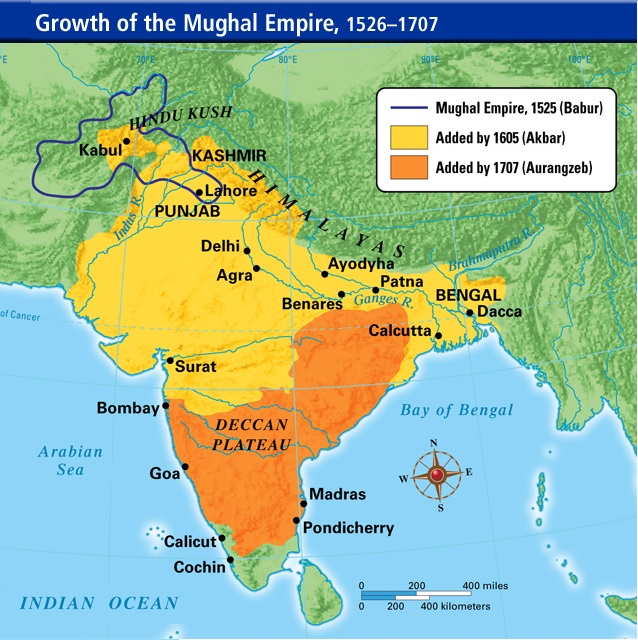
    And here is the Mughal Empire as a quick comparison - 


    Image credit

    Right, that's enough already. Let's get into the main topic for today - vegetable dyes.


    Like everything textile-related, the roots of the vibrant colours of Indian textiles, pardon the pun, goes back to the Valley. The Indus Valley. Dye vats and fragments of madder-dyed cotton wrapped around a silver pot have been found in Mohenjo-Daro, it shows an advanced level of knowledge of mordant dyeing and colour fixing. Similarly, the Priest-king we saw at the start of the series wears what is believed widely to be a madder dyed textile robe. Artisans knew the use of madder and indigo to obtain vivid red and blue for textile dyeing four/five thousand years ago. In fact for long centuries Indian red and blue were kind of colour monopolies in the textile trade. Not just that, they had precise knowledge and control of the dyeing process to get a range of shades from 'dawn flushed' as mentioned in a Chinese text in the 7th century, to deep, intense reds and blues. Banabhatta, a poet and writer from Kanyakubja (modern day Kannauj, UP) mentions costly tie and dyed textiles in various designs, also in the 7th century. A French traveller in the 18th century mentions the colour fastness of Indian textiles that lasted the entire life of the garments. In short, there is no dearth of evidence on the knowledge and skillfulness of Indian textile artisans regarding colours/dyes.


    The Indus Valley Civilisation vanished by 1500-1400 BCE, there's no tangible archaeological record for a few centuries within India itself. However, the Greek historian and physician Ctesian mentions brightly coloured cotton from India in the 5th century BCE. Ctesian was the court physician in the Persian Empire at the time, known for his texts Persica and Indica - these show that Indian textiles continued to be exported to Persia during the 1st millennium BCE even after the collapse of the IVC and the rise of newer dynasties and empires. This trade in Indian textiles continued and expanded to progressively include Greece, Rome and rest of Europe, as well as the New World, right through to the 18th century, when the Industrial Revolution and discriminatory colonial policies brought Indian trade supremacy to an end. 


    Natural dyes can be classified into three broad types - vegetable, animal and mineral - according to their source. Another broad classification can be as per their application techniques - vat dyes, mordant dyes and direct dyes. Vat dyes are those which are insoluble  in water but become soluble when treated with a reducing agent, i.e. they require 'vatting.' Mordant dyes are those that require a binder, usually a metal salt, to adhere to the fabric. Direct dyes, as the name implies, are dyes that can be applied straight to the textiles. The most common mordant used was alum and iron sulphate. Other  mordants were also known but they were extremely toxic and impact both the artisans and the environment and so have been discontinued in modern times. Many dyes and also mordants are malodorous therefore dyeing communities tended to operate in separate enclaves outside the main towns. 


    Dyeing can be done on fibre itself before spinning ('dyed in the wool'), after spinning or 'yarn-dyed' and after weaving that is 'piece dyed.' Indian sarees use both the latter processes extensively. For example, Batik and Ajrakh sarees are printed as pieces, while most Kanchipuram and Ikat sarees are woven after dyeing the yarn. 


    Some of the more important vegetable dyes that Indian artisans used were  Indigo (blue), Madder (red , burgundy and lilac), Turmeric (yellow), Saffron (orange to yellow) Safflower, Parrot tree flowers and Pomegranate. Read more about Indian dyes used here and here.  


    Synthetic dyes were developed in mid-19th century and changed the textile industry - natural dyes were replaced by their synthetic counterparts. These were easier and quicker to produce on a mass scale, and unlike natural dyes, could be used for manmade fibres/fabrics as well. Note that the first man made fibres happened to be created in the 19th century too. 


    In recent times, there is a movement towards the use of natural dyes as the negative environmental impact of chemical dyes have become apparent and consumer consciousness about health and sustainable practices has grown. 


    Watch this short film on the history of Indian natural dyes below. Vibrant coloured textiles remain a part of life in modern India and continue to play an important role in traditional attires of both men and women. 


    ~~~


    Did you know that lac is a natural dye? - it's obtained from insect resin and used to dye textiles. It yields colours ranging from crimson to burgundy red and deep purple. 


    Thank you for reading. And happy A-Zing to you for the end days of the challenge if you are participating. 


    A-Z Challenge 2025 

    Wednesday, 23 April 2025

    T is for .... Tiny ... n ... Timeless


    All this month I am writing about outstanding Indian handlooms, a quick but captivating dive into the saree specifically, a garment worn by Indians for five millennia. Come with me into the magnificent, complex and utterly fascinating world of fibre and yarn, of skills and techniques of dyeing and printing and embroidery, traditions unchanged for centuries. Of sumptuous finished fabrics that not only make a fashion statement, but also constitute our cultural heritage and political identity.


    T is for Tussar 


    Tussar (also known as Kosa silk) is a type of silk obtained from the cocoons of wild moths. Watch this short film on how Tussar is produced in a village in Jharkhand in the east of the country. 


    Like the other silks of India, Tussar also has a rich history with its potential origins being in the Indus Valley Civilisation. Tussar is essentially a non-mulberry, non-cultivated silk. The Tussar silkworms grow on a diet of  Arjun and Indian oak in the forest, from where tribal communities have been collecting the cocoons and creating this type of silk for many centuries. These cocoons yield shorter silk filaments and therefore Tussar has a slightly uneven texture and coarser feel. It is breathable making it suitable for the tropical climate of India and it combines well with other yarns such as wool, therefore its export potential is excellent.


    The colour of the silk obtained from silkworms of any variety depends on the leaves they feed on and the climatic conditions they are growing in. Since the Tussar silkworms feed on a variety of leaves, the colour of their silk varies from off-white to old gold to honey and shades of beige/brown. The variation as well as the texture are highly prized. In short, Tussar has a unique, rustic feel and is a niche market. 


    Plain woven, plain dyed and hand block printed Tussar
    sarees from Bihar, Odisha and West Bengal. Except for 
    the flat dyed one, the colour of the original fabric is 
    visible in all the others. 


    Note that not all Tussar is violence-free, some are made from living cocoons. Only Ghicha (pr Ghi-cha as in chair, not -ka as in the film) is made from spent cocoons. However, Ghicha has become more popular in the last few decades as consumers have become more conscious of environmental considerations and sustainable practices. To ensure that the larvae can go on to complete the life cycle and reproduce makes much more sense than killing the wild silkworms. 


    Tussar has a share of less than 4% of the production of silks in India, a very tiny quantity indeed. It is produced in Assam, Bihar, Jharkhand, Odisha, Madhya Pradesh, Chattisgarh and West Bengal. The lion's share of production goes into sarees - for Kantha, Madhubani, Pata Chitra, hand block printed and Batik mainly, though some of the fabric is used for stitched apparel as well.  The market volume may be tiny but Tussar's appeal is quite timeless. Read more about Tussar here and here. 


    ...also for Textile historian and Tradition


    I also wanted to tell you about Rta Kapur Chishti, a well known textile historian who has recorded the regional weaving and wearing of sarees. She has documented over 100 ways to drape saris in a book she coauthored with Martand Singh, another giant textile academic. She also runs a programme called The Saree School, where the techniques to tie a saree and its different drapes are taught. 


    Image credit


    Btw, in Hindi Taana refers to the warp and Baana to the weft yarn in weaving, both must be perfectly in sync - the tension just right, the alignment perfect, nothing torn, nothing a single millimeter out of place - for the fabric to form, the pattern to shape up. Everyday art. That is centuries old and still going on. And you can just grab it off a shelf and wrap yourself in it in two ticks - six unique yards of tradition. If that is not clean breathtaking, I don't know what is.


    ~~~


    Did you know that the twist of the yarn determines the durability and lustre of silk? Yarns that have been highly twisted are stronger than yarns which are low twist. High twist yarns are used in the warp usually - they are stronger but of lower sheen, while weft yarns can be low twist and more lustrous.


    Thank you for reading. And happy A-Zing to you if you are participating in the challenge. 


    A-Z Challenge 2025 

    Tuesday, 22 April 2025

    S is for ... Stunning ... n ... Sumptuous


    All this month I am writing about sumptuous Indian handlooms, a quick but captivating dive into the saree specifically, a garment worn by Indians for five millennia. Come with me into the magnificent, complex and utterly fascinating world of fibre and yarn, of skills and techniques of dyeing and printing and embroidery, traditions unchanged for centuries. Of stunning finished fabrics that not only make a fashion statement, but also constitute our cultural heritage and political identity.


    S is for Silk


    Silk, like cotton, goes back a long way in India. The earliest Indian literature/text, the Rig Veda mentions 'Hiranya vastra,' or cloth of gold. Chanakya mentions silk and a silk weavers guild, also the importance of the silk trade, in his 3rd century BCE treatise on statecraft and strategy Arthashashtra. 


    There are remnants of silk obtained from wild moths among the archeological artefacts found in Harappa, showing that the Indus Valley Civilisation was familiar with silk yarn, though it cannot be said with any certainty if they wove it into fabrics or not. The silks found in Harappa and Chanhudaro have been dated to 2450-2000 BCE, so silk was used in India at least four millennia ago. With the collapse of the Indus Valley Civilisation in 1400 BCE, the knowledge and usage of silk was lost. While many Western scholars are of the opinion that silk came back to India along the silk roads from China, some Indian historians feel the knowledge of sericulture  and silk weaving was revived in India itself, somewhere on the lower slopes of the Himalayas. 


    Elephant motif on shot colour Kanchipuram silk saree.


    Anyway, academic arguments aside, what we do know is that ancient Buddhist texts mention that when Prince Siddhartha renounced his princely life to become a monk, he removed his luxurious silken robes. Kashi (the older name for Varanasi/Benares) was known as a silk weaving hub according to Pali literature. And as per Jataka tales, the Kashi kingdom was famous for its fine cotton and silk weaving traditions. Therefore, Varanasi's silk weaving was thriving by Buddha's time - roughly 2500 years ago. Similarly,  evidence of silk weaving is available for Paithan in Maharashtra, part of the then Satavahana empire which lasted from 230 BCE to 220 CE.  Actual Indian silk fragments have been discovered in ancient Syrian graves. It is known that there was established silk trade with Rome with the Kushan Empire of the 1st century CE. So clearly India was exporting silks to the Middle East and West by then. So that's that - whatever may have been lost, it had been recovered as the Common Era started.  


    Paithani silk with typical Narali borders and peacock pairs in
    the aanchal. This was a gift from my cousin at her wedding.
    Paithan is a very ancient silk weaving centre famous for these
    colourful sarees with characteristic motifs and gold thread
    work.


    Silk hubs emerged in Ancient India around holy temple towns and capital cities, as silk was used to clothe the deities and royalty. Rich merchants also contributed to the growth of the silk industry by defraying the cost of expensive raw materials and financing the weavers. Varanasi, Malwa and Gujarat were the main centres. Silken fabrics have always been considered 'purer' and more auspicious than cottons, therefore suitable attire for any religious event. In Bengal for instance, a special red bordered undyed white/off-white silk saree called 'Garad' is worn for religious ceremonies like the Durga Puja even today.  


    During medieval times, Indian silk production boomed under the Mughals. Akbar the Great (reigned 1556-1605) had a special interest in silks, he set up textile workshops in Lahore, Agra and Delhi and other cities, brought in artisans both from Persia and Gujarat to train local weavers. Akbar's son Jehangir continued his father's work and patronised the arts generally and textiles in particular. It was in his time that Bengal emerged as a major weaving centre and the already existing hubs were further strengthened.  Brocade and velvet weaving, paisleys, intricate floral motifs, delicate gold thread work and chikankari white on white shadow work are some of the techniques that developed as a result of this Persian influx and influence. The textile industry thrived. Read about the Mughal influence here. 


    Bichitrapuri ikat silk from Odisha.


    As of today, India is the second largest global producer (~ 40,000 MT annually) and exporter of silk after China (~150,000 MT annually). While China consumes about 50-60% of its silk domestically, in India the share of domestic consumption is much higher, pegged around 85%. India has a robust internal market for silk and it even imports a fairly large quantity of silk from China. Well, naturally. Silk is not just used in sarees, but also in dress material, made up garments and home furnishings including carpets. And even by the most conservative estimates, India has an upper middle class of around 45-50 million, greater than the entire population of say, Canada, Australia or Taiwan. Have a peek at India's sericulture statistics over here. 


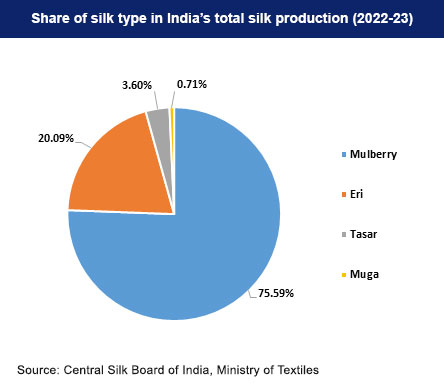
    India produces a variety of silks as shown in the chart below:


    Image credit.

    Mulberry silk has the largest share of silk production in India, as well as globally. This particular type of silk is obtained from the larvae of the cultivated silkworm species known as Bombyx mori and gives the most prized, shiniest silk. 

    Woven paisleys on the aanchal of a handloom
    Bishnupur silk from West Bengal.


    The others make up less than a quarter of the production volume. These are from species found in the wild, they give a so-called 'poorer' quality, more uneven textured, less bright and less dyeable silk. Some silks are also obtained from 'spent' cocoons i.e. the cocoons from which the metamorphosed insect has flown out. These are called Ahimsa or peace silks, they are particularly favoured by faiths that forbid the taking of animal life e.g. Buddhism, Jainism. 


    Bengal cotton handloom with plain borders of Muga silk
    and narrow Muga stripes in the body. A gift from my
    grandmother in the mid-70s. 


    The vast majority of mulberry silk is produced in the southern states of Tamil Nadu, Karnataka, Andhra Pradesh and in the east in West Bengal. Two other varieties are produced in Assam mostly, Muga especially is GI tagged to Assam. Eri is produced in other North Eastern states also. We'll get into more details of these silks in subsequent posts.  


    ~~~


    Did you know that silk is basically protein? The shimmery quality of silk comes from the intrinsic properties of the filament. The silk filament is made up of two kinds of proteins - an inner core of fibroin and an outer covering of sericin which holds the filament together like glue. Fibroin is smooth, has a prism like structure and can refract light at different angles. Sericin is uneven textured. The degumming process removes the sericin and exposes the fibroin. The sheen of silk therefore depends on the extent of degumming. Read more here. 


    Thank you for reading. And happy A-Zing to you for the rest of the challenge if you are participating. 


    A-Z Challenge 2025 

    Monday, 21 April 2025

    R is for... Ripples ... n ... Red Carpet


    All this month I am writing about the richness of Indian handlooms, a quick but captivating dive into the saree specifically, a garment worn by Indians for five millennia. Come with me into the magnificent, complex and utterly fascinating world of fibre and yarn, of skills and techniques of dyeing and printing and embroidery, traditions unchanged for centuries. Of sumptuous finished fabrics that not only make a fashion statement, but also constitute our cultural heritage and political identity.


    R is for Role


    Image credit 
    Shabana is wearing a Kanchipuram silk, Smita is in a Odisha Bichitrapuri ikat.
    Both were towering actors of the Parallel cinema movement in India in the 70s/
    80s. Smita unfortunately passed away shockingly early in 1986 due to post natal
    complications, Shabana has gone on to give over 160 films and is still performing.
    She is also an activist for women's rights and other disadvantaged groups. Both 
    actors shaped the film and fashion sense of their niche audience.


    Indian cinema, Bollywood and regional both, have had a huge impact on fashion generally, and sarees specifically, long before celebrity culture became ubiquitous due to social media. Today I'm going to cast a look back and explore the role Indian films and film stars have played, on and off-screen, on the fortunes of the saree. 


    Before we get into the details of celebrity fashion, just a few dates to pin the context in place - the first Bollywood film was made in 1913, the first 'talkie' in 1931 and the first colour film in 1937, that's when the costume designs would have really taken off. However, films continued to be made in black and white well into the 60s, the last b/w film was produced sometime in the mid-late 60s. 


    In the 50-60s, Suchitra Sen had risen to stardom in Bengali regional cinema, she was called 'Mahanayika' (lit Great Actress) and her fashion choices influenced a generation of Bengali women including my mother and aunts. She was a trendsetter in sleeveless/short sleeved and lace blouses with varied necklines which were copied avidly by her huge fan following. 


    In Bollywood meanwhile,  actors such as Sharmila Tagore (from the same family as Jnanadanandini Tagore!), Waheeda Rahman, Mumtaz and Mala Sinha made ripples in the fashion world. A huge craze was created with a new drape showcased in a song sequence from Brahmachari (1968), given below. This particular style became famous as the "Mumtaz saree." 


    During the 60s and 70s, sarees were markers of stereotypical characterisation - a virtuous Indian mother, sister, wife/fiancée wore sarees while the vamp wore western/bolder clothes equated with permissiveness.  However, many of the sarees the heroines were dressed in were mill-made printed voiles, polyester chiffons and georgettes. They replaced the hand made ones with mass produced copies of Bandhni and Ikat style handlooms. Successful female actors (e.g. Parveen Babi) endorsed/modelled mill made sarees and wore them in their film roles in the 70-80s (e.g. Vidya Sinha in Chhoti Si Baat, 1976).   


    Sridevi, the first female superstar of Bollywood, came to Hindi cinema already a veteran of South Indian films, and rose to stardom in the late 80s. Watch her in this song and dance sequence from the 1989 hit Chaandni below - she wore sarees in many of her most memorable roles/scenes, particularly chiffons, another iconic look from her was in Mr India (1987) in a plain blue one. It's said that she single-handedly upped the demand for chiffon sarees manifold during the last of the 1990s. Read about her fashion influence here.  However, she favoured Kanchipuram silks and other heritage weaves in her personal wardrobe, as did Rekha, another legendary Bollywood diva.


    Image credit. Sridevi at the premiere of English Vinglish at the
    Toronto International Film Festival.

    As the 90s faded and a new millennium started, Bollywood costumes gradually swung away from traditional Indian sarees, swamped by the ever rising tide of globalisation. The younger generation of actresses wore athleisure and more casual western fashions along with a smattering of sarees when required, e.g. the courtroom scene in Aitraz (2004) or Deepika's character in Chennai Express (2013). 


    At around the same time the phenomenon that is social media made it possible 

    1) for particular scenes/songs and costumes go viral within hours of the release such as the blue saree of Deepika Padukone in Yeh Jawani Hai Deewani (2013) and the 'string' aanchal of Kareena in Heroine for example. 
    2) the 24/7 fan access to strictly curated, PR-managed star personas and private lives. 


    In the early 2000s, the then leading lady of Bollywood, Aishwarya Rai became the brand ambassador for L'Oréal, she was already an ambassador for Longines by then. Time magazine included her in their list of 100 most influential people in 2004. The glam quotient of Indian stars which was already pretty robust at home soared into the stratosphere. Subsequently several others - Deepika Padukone (Louis Vuitton, L'Oréal, Adidas), Priyanka Chopra Jonas (Bvlgari, Cartier), Sonam Kapoor (Dior), Alia Bhatt (Gucci) Ananya Pandey (Swarovski, Chanel) - have become brand ambassadors. 


    Many Bollywood stars have appeared in designer saris on the red carpet at various international events (Cannes, Met Gala) as also in heritage weaves for award functions or other cultural activities. Meanwhile, international celebrities have also showcased sari inspired fashion on the global stage from the early years of the 21st century. 


    Image credit 
    Naomi Campbell at the 2023 Met Gala in
    a sari inspired Chanel archival number.


    Read more about the impact of Bollywood stars and other celebrities on our handloom heritage here and here. 


    One of the spin-offs of stars being on social media has been the vicarious consumption of Indian celebrity weddings. Till recently, actors kept their weddings under wraps as single stars were considered to have a more 'marketable' image for the usual Bollywood romantic formula fare. But that has been ditched in these last decades - curated wedding photos of Priyanka Chopra Jonas, Anushka Sharma, Deepika Padukone - Ranvir Singh, Alia Bhatt - Ranveer Kapoor, Katrina Kaif, Sonakshi Sinha among others, have been available on social media almost instantaneously after the ceremonies. 


    It may be questionable taste to turn a greatly significant private milestone into a gaudy social media spectacle, but it does focus public attention on the textiles. Celebrity bridal attire has trended on a viral scale, usually consisting of designer handwoven and/or hand embroidered fabrics. This has promoted knowledge and awareness of our heritage weaves like Bandhni, Benarasi and Kanchipuram. 


    YouTube and Instagram influencers, as well as fashion analysts, have recreated star looks based on cheaper imitations. A whole new trend of pastel toned/ivory bridalwear has taken off based on some celebrities ditching the traditional Indian bridal red. A whole new industry too - that of wedding planning and event management, has taken shape.


    Of course celebrity attire remains way beyond the means of most of their fans. So how much of actionable impact this has had for ordinary women beyond just aspirational value remains to be seen. Whether star power can reverse the slow erosion of skills and rev up the demand for handlooms is still unclear. 


    ~~~


    What do you think about stars promoting/wearing sarees, do you think it helps the cause of handlooms? 


    Thank you for reading. And happy A-Zing to you for the rest of the challenge if you are participating. 


    A-Z Challenge 2025 

    Saturday, 19 April 2025

    Q is for ...Quagmire ... n ... Quail, definitely


    All this month I am writing about quintessential Indian handlooms, a quick but captivating dive into the saree specifically, a garment worn by Indians for five millennia. Come with me into the magnificent, complex and utterly fascinating world of fibre and yarn, of skills and techniques of dyeing and printing and embroidery, traditions unchanged for centuries. Of sumptuous finished fabrics that not only make a fashion statement, but also constitute our cultural heritage and political identity.


    Q is for ...


    ...a fearsome quagmire that makes me quail. Every year...without fail. But I am super lucky that I can yell for help from my third home that once was, for a quick fix. 


    So. Q is for Qutn...which you will immediately recognise for what it is, the Arabic word which gave the most widely used natural fibre its name - cotton. The very heart of Indian handlooms, exported for centuries from antiquity. 


    The history of cotton use is deep and rich, though its exact origins are still shrouded in mystery. It is thought that cotton was discovered independently in different places. Cotton has been known for millennia - the earliest archeological evidence has been found in ancient civilisations in Asia, Africa and South America. 


    Image credit. Earliest evidence of cotton cultivation in the ancient
    world. Dates in years BP. 


    In the Indian sub-continent, evidence of cotton textiles have been found at Mehrgarh, a Neolithic site predating the Indus Valley Civilisation. And we've already seen that something akin to Ajrakh pattern textiles were in use in Mohenjo-Daro four thousand years ago. Excavations there have revealed dye vats with woven fragments of madder-dyed cotton indicating knowledge of weaving of fabrics and dyeing techniques.  


    The cultivation of cotton started in the Indus Valley Civilisation (of which Mohenjo-Daro is a part) by 3000 BCE. Cotton is mentioned in the Rig Veda, those hymns being written in Sanskrit in roughly 1500 BCE, the oldest religious/literary compositions known to us. The Sanskrit words for cotton 'karpas' and 'karpasum' travelled west into Latin as 'carbasus.' So it can be safely inferred that cotton was known and grown in India deep in antiquity, and the trade in it became so developed that it became as inextricably associated with India as silk was with China.  


    Famous Greeks have mentioned Indian cotton - Herodotus wrote about Indian cloth as 'the wool exceeding in beauty and goodness than that of sheep' in 5th century BCE. Strabo too wrote about the vibrance of Indian textiles.  Arrian mentions the trade in Indian cottons in 130 BCE.


    The Book of Esther (written 4th-2nd century BCE) has a reference to blue and white striped cotton hangings in the royal palaces of King Ahasuerus (widely believed to be Xerxes I by historians) -  further evidence of the cotton trade with the Persian Empire. Read more about that here.


    Chinese travellers to India - Faxien in the 5th century, Xuanzang a couple centuries later, both mentioned Indian cotton and weaving hubs that they encountered in their travels.  European explorers who came east such as Marco Polo and Vasco da Gama also record the vividness and superiority of Indian fabrics. In sum, there is no shortage of sources who confirm the excellence of Indian handloom cottons from the earliest times to the 18th century. 


    The spinning wheel or charkha came into use in India sometime between 13th/14th century and it is still used at present to produce handspun handwoven premium sarees. We have seen earlier how the charkha was used in India's freedom struggle and represented self rule/self reliance. The diffusion of the charkha through out the sub-continent increased yarn production and therefore boosted the textile output also.


    During the Mughal period (1526-1857) cotton cultivation and the Indian textile industry boomed. The third Mughal Emperor, Akbar the Great (1566-1605), introduced a series of agrarian reforms and replaced the tribute system with a new tax regime called zabt, based on a uniform monetary currency. The state funded irrigation systems that increased crop yields and therefore the tax base. 


    The system favoured cash crops and therefore cotton as well as indigo were given a fillip. By the time the Portuguese, followed by the Dutch, French, Danish and finally the British landed up, the Mughal Golden Age was at its height. When Jehangir, Akbar's son, granted the first permit to the East India Company to set up a permanent factory in Surat in 1613, India had an estimated 25% of the global GDP. The Bengal Subah (province) itself contributed around 12%, cotton textiles being a significant export. 


    (Indian chintz)…crept into our houses, our closets, and bed-chambers; curtains, cushions, chairs, and, at last, beds themselves were nothing but calicos or Indian stuffs… almost everything that used to be made of wool or silk, relating either to the dress of women or furniture of our houses, was supplied by the Indian trade…

    ~ Daniel Defoe, in The Review, 1708.


    Industrialisation paired with the discriminatory policies of the British Raj brought to an end the Indian supremacy in cotton textile exports in the 18th-19th century. Many skills were lost and several types of sarees disappeared such as the 'woven winds' Muslin and the Baluchari.


    The Treaty of Allahabad. Signed in 1765 between Mughal 
    Emperor  Shah Alam II and Lord Robert Clive of the East 
    India Company. This treaty granted EIC the right to act on 
    behalf of the Mughal state, & changed the Indian economy 
    in fundamental ways forever. 
    Exhibit in the Reserve Bank of India Museum.


    As discontent boiled over and the struggle for self determination intensified, the coarse handspun handloom cotton was weaponised as a tool for political resistance and as a symbol of self rule. 


    The Indian textile industry was built up again after independence was achieved in 1947. The Baluchari for instance was revived and woven on jacquard looms from the mid-20th century. And Bangladesh has revived the Dhaka Muslin in 2022. It has also clawed back the second largest share of global textile exports (8%)  after China (31%) in 2021 and has retained that position since. 


    India's performance is not as stellar but remains strong, it is among the top 10 textile exporters globally with a current share of around 4%. India is also the second largest producer of cotton and has around 17% of the world production. 


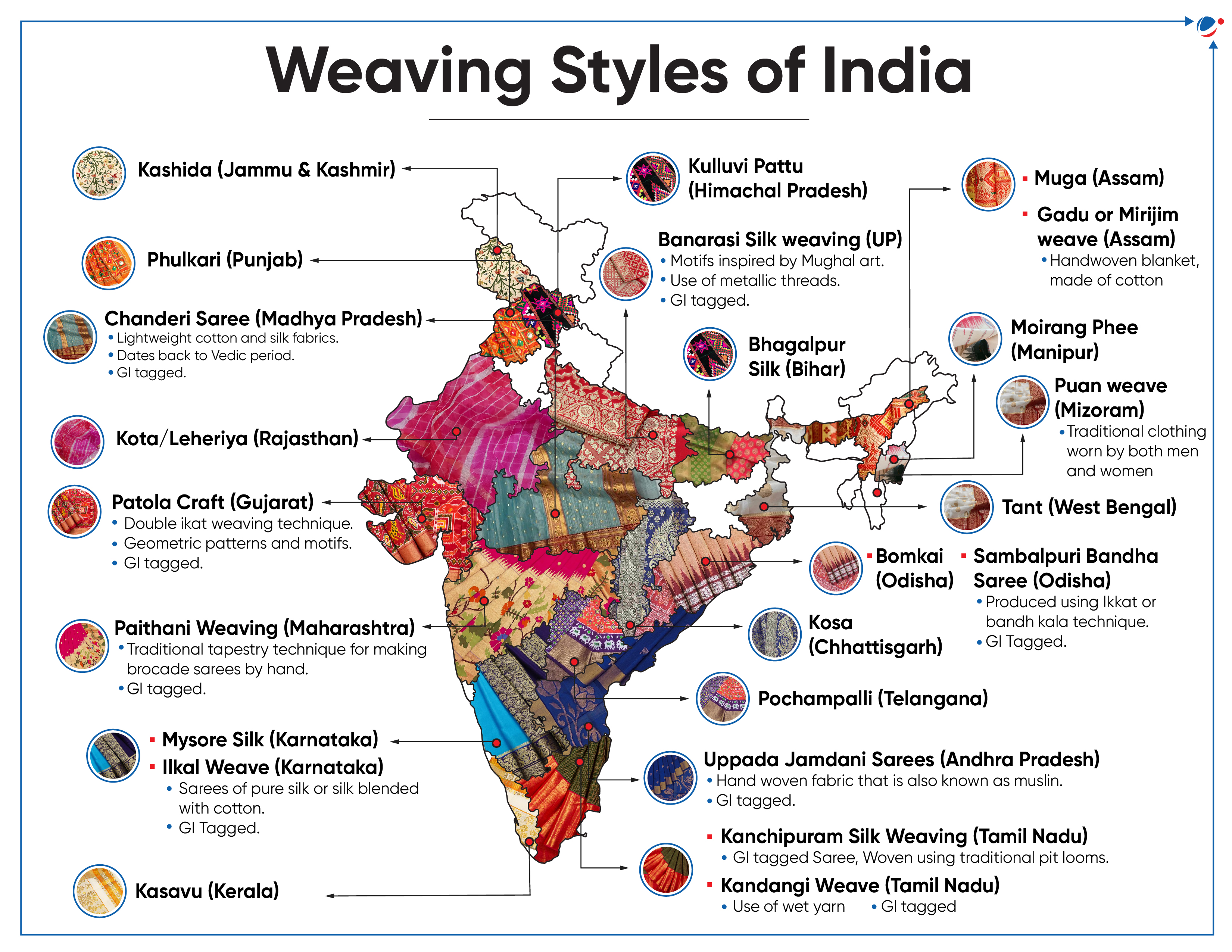
    Image credit Map of India giving the main weaving states
    and the handlooms they produce.


    ~~~


    Did you know that the current percentage share of cotton is 24% in all yarns? Now that's less than a quarter of all fibres used globally. Polyester surpassed cotton in 2002 to become the most widely used material. However, for nearly 7000 years cotton was the primary material used in garments. 


    Thank you for reading. And happy A-Zing to you if you are participating in the challenge. 


    A-Z Challenge 2025