Saturday, 17 April 2021

O is for ... Own ... n ... Ordinary


Last night I had fried okra for dinner and thought right, I have my O post. But most of my folks would have a different opinion. Because they call it ladies’ fingers in India, very evocative and all that, but the thing is, I grew up in places where it was called okra or okro, neat and on-point. And in the case of okro, nicely symmetrical vowel sounds. So I’m more comfortable with the shorter name. Whatever name you call it – okra has a long, fascinating and somewhat disturbing history behind it. 


The origins of okra are in Africa, surmised to be in the areas now in modern day Ethiopia and Sudan, then spreading from there to the north and west. The Ancient Egyptians grew okra by 1200 BCE. There are murals in Egypt which depict the vegetable. Okra went east with the migrations of the Bantu tribes and grew along the major river valleys in India and China by 2000 BCE. The uses/benefits of okra are known to Ayurveda, an ancient Indian system of medicine that arose in the 1st millennium BCE. However, we do not have any hard evidence of okra being eaten in the Indus Valley. Specific mention of an okra recipe is made in the 12th century, a dish being served to Someshwara III, a Chalukya emperor who ruled in southern India in 1126-38. The next bit of documented evidence comes from  a Spanish Moor who visited Egypt in 1216. He recorded that okra was combined with meal to reduce the mucilage. 


Okra went west with the slave trade. African slaves brought it to the Americas with them, cultivated and cooked it as a reminder and a legacy of their lost homelands. Leah Penniman, the food justice activist, describes her ancestors collecting and braiding seeds into their own and their children's hair as a bulwark against an uncertain future, so they could carry an inheritance of tilling into an unknown land. Maybe okra too came to the New World this way, crossed the Atlantic and reached southern USA in the 1500s. 


Okra was cultivated in the slave quarters in personal gardens by people from many different regions/communities of Africa. They cooked it up in equally varied recipes, in soups and stews, fried and seared. The seeds were roasted, ground and used as a coffee substitute. It became a mainstay for the enslaved workers, especially under the harsh conditions of forcible food withholding by slave owners. And because okra is a fast growing, undemanding, robust plant, it established itself across the south where the climate was conducive. But cuisines don't remain static, they evolve and assimilate influences and ingredients - give rise to newer dishes. So okra too was added to local foods to create/innovate newer recipes and gradually became an integral part of the southern American cuisine.


An ordinary vegetable with an extraordinary, fascinating history. 


A-Z Challenge 2021 

Friday, 16 April 2021

N is for ... New ... n ... Need ...


Today is the start of the Bengali New Year 1428 – so shubho noboborsho to all those observing. A number of regions and communities in India mark the beginning of the year around mid-April. But both January and April as starting points seem a little strange to me because, well, why should anyone begin the year when it’s bitterly cold or scorching hot? Isn’t spring a much more natural choice? It’s a question that’s been niggling at me for sometime.


But before we look at the history of time keeping and calendars and such like, an intriguing and more fundamental question is - why? What is the need for humans to mark days and months and years? One obvious answer is of course agriculture - once humans starting farming, they had to keep track of the seasons. But that doesn't explain the mystery of the Ishango bone, which I have talked about in one of my earlier A-Zs. One of the theories is that the Ishango bone marks a six month lunar cycle, possibly to keep track of a woman's menstrual cycle, some 18,000-20,000 years ago. This is an educated guess only - it cannot be conclusively proved with that length of time. But isn't it nifty! to imagine a woman that long ago notching a handy bone to make sure she knew her cycles, wow!


The evidence of timekeeping goes back deep into prehistory, to Neolithic times. Agriculture happened many millennia before humans learnt to write things down. Archaeologists have found megalithic structures that likely tracked the solstices, i.e. the solar year and seasons. Such arrangements have been unearthed in Victoria, Australia (11,000 y.a.) and Aberdeenshire (10,000 y.a.), to mention just two. Europe has some 35,000 megaliths, some of which are arranged in astronomically aligned circles. The most famous of these is of course, Stonehenge, which dates to around 5000 years ago. 


The Sumerians, Ancient Egyptians and the Assyrians were some of the first civilisations and therefore first to devise formal calendars. In fact, the Egyptian Coptic calendar in use today is based on the Ancient Egyptian calendar, and farmers in Egypt still follow the three seasons of Inundation, Growth and Harvest as marked in Ancient Egypt to seed and harvest their crops. The new year, called Nayrouz, starts on 11th/12th September, what used to mark the flooding of the Nile before it was dammed. 


The Babylonian calendar was a lunisolar one and by 2000 BCE they observed a spring festival and marked the new year in March around the vernal equinox. The Persian calendar dates back to the 2nd millennium BCE and has been tweaked many times as dynasties rose and fell, wars were won or lost. One of the major tweaks in the 11th century was done by none other than Omar Khayyam, who was also an ace mathematician and astronomer in addition to being an ace poet. He designed the Jalali calendar that provided the basis of the calendar in use currently in Iran, even after a millennium. The new year in the present Iranian calendar, known as Nowruz, is still marked on the first day of spring. 


The early Roman calendar also designated 1st March as the start of the year. Ancient Romans divided the year into ten months, something that's apparent even today. The names of the last four months - September, October, November and December reflect the ten month calendar (Septem, Octo, Novem and Decem are Latin for seven, eight, nine and ten respectively). January and February were devised and tacked on, according to legend by the second king Numa, first at the end of the year, but at some point got moved to the beginning. New Year celebrations were moved to 1st of January to coincide with the practice of inaugurating the new consuls on that day. But private and religious celebrations continued to mark March as the new year still. 


The fundamental problem with any calendar is that the astronomical year does not have a whole number of days nor a whole number of lunar months. Nor does a lunar month have a whole number of days. There are always fractions left over which result in slippages and cycles becoming misaligned. Over time, the differences can become substantial. That is why Julius Caesar in 46 BCE reformed the Roman calendar by edict, the reforms taking effect from 1st January 45 BCE. The Julian calendar remained the predominant calendar in the Roman Empire and the Western world for more than a millennium. However, even after local calendars were aligned to it, they still began the year on different dates. The concept of the New Year's Day remained quite fluid right up to medieval times. 


Although the Julian calendar was adopted widely and remained in use for nearly 1600 years, it contained a slight inaccuracy in the measurement of the solar year. That caused the seasonal dates to regress by one day in a century. Pope Gregory XIII reformed the Julian calendar to rectify this slippage in 1582.  This is the calendar most widely in use across the world today, only Iran, Afghanistan, Ethiopia and Nepal do not use the Gregorian calendar. Most Western countries adopted the Julian/Gregorian calendars over a period spanning 16th to 18th century and then introduced it to their colonies. Many countries use the Gregorian as a civil calendar and a different liturgical calendar (Hijri, Coptic, Hindu) for religious festivals. This is why the Bengali new year does not start on 1st January.  


A-Z Challenge 2021  

Thursday, 15 April 2021

M is for ... Museum ... n ... Millennia ...


According to the International Council of Museums (yes, there is one!) a museum is defined as 'a non-profit, permanent institution in the service of society and its development, open to the public, which acquires, conserves, researches, communicates and exhibits the tangible and intangible heritage of humanity and its environment for the purposes of education, study and enjoyment.'  There are myriad types of museums -  55,000 of them spread across 220 countries as per the ICOM including art museums, natural history museums, science museums, war museums, textile museums, maritime museums and so on. There are tiny museums with a focus on local history and ones with vast collections which draw millions of visitors from all over the globe.


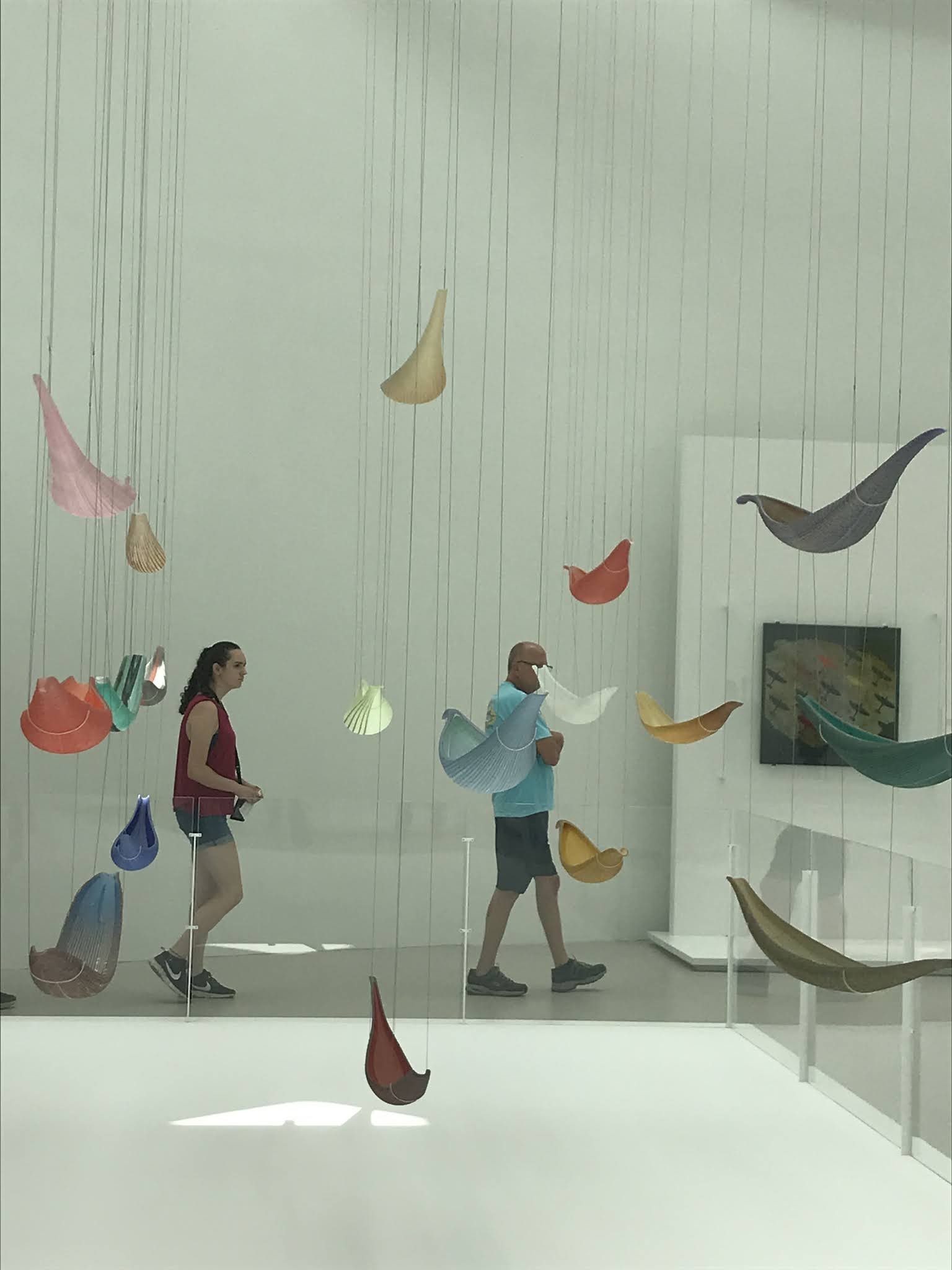
For myself, I take a vague, mishmash interest in 'heritage' and I take 'enjoyment' very seriously indeed, so museums are my go to for mood upliftment. They are often the starting point of trip planning and actual exploration of a new place. When I can't visit them physically, like in these two un-mentionable ghastly mess of years 2020-21, I visit their websites and browse instead. Many of them provide great resources for research and rabbit holes where one can merrily be lost for hours. This entry is mainly made up of my photos of some museums I have visited. 


Collection of 15th century Islamic glassware at...


...The Bahrain National Museum


Beit al Quran (House of Quran) Bahrain. 


The earliest museums started off as private collections of individuals or institutions, of art objects and curiosities to be displayed in purpose built rooms or cabinets. The very first recorded museum dates from 530 BCE in the Chaldean Empire, built by the Princess Ennigaldi, containing items from earlier Mesopotamian civilisations. Interestingly, a clay drum label was found at this ancient museum site - it describes the recovery and history of a museum artefact in three different languages. Throughout the ages, wealthy individuals - monarchs, landowners and merchants have curated interesting stuff and shown them off to selected, invited guests. A status symbol and an exploration of their worlds past and present.


The Colossi of Memnon, Luxor, Egypt. A millennia
old open air museum of one of the earliest civilisations.


Rameses II. Memphis, Egypt.


Master bedroom in Ottoman merchant style.
Gayer Anderson Museum, Cairo, Egypt.


The Boy Jockey. Sculpture at..


...The National Archaeological Museum, Athens.


Socrates. Delphi Museum.

Some of the famous museums visited today were started during the Italian Renaissance. For instance, the Capitoline Museum, the oldest collection of art objects in the world, started off in 1471 when the Pope, Sixtus IV, donated a collection of sculptures to the people of Rome.  Similarly, the Vatican Museums started in 1506 around a nucleus of sculptural objects when Pope Julius II decided to put them up for public display. 


Roman jewellery at National Archaeological Museum,
Amman, Jordan.


Coat of Arms of Pope Gregory. Pope who? that's the
man whose calendar we follow. Vatican Museum.


Musee Rodin. Mind blowing! But not the most
visited in Paris.  That's the Louvre, where the 
Mona Lisa is.


Musee d'Orsay, Paris. Another magnificent one!


Museo Nacional del Prado, Madrid. One of the largest
collections of European art with over 21,000 works 
spanning 12th to early 20th century.


Modern museums originated in the West and spread to other areas. The British Museum started with donations from Sir Hans Sloane as its founding collection in 1753. It was opened to the public in 1759.  The Louvre, which is a former palace, was opened to the public in 1793. It is the most visited museum in the world with more than 10 million visitors annually, pre-pandemic of course. Incidentally, most of the top globally visited museums have visitors numbers down by 60-80% in 2020 over the previous year. Super concerning!


Victoria Memorial. Calcutta, India.


Emperor Ashoka's Edict, 3rd century BCE. Exhibit at the 
Prince of Wales Museum, Mumbai. Now renamed
to Chhatrapati Shivaji Maharaj...sangr%^&*
(unpronounceable Indian word for museum). Why 
everything has to be renamed to the gills beats me
hollow! Rather maddening.


British Museum, London, UK. Must visit! on every trip.


National Museum, Dubai, U.A.E.


Goddess Minerva, deity worshipped at the
Roman Baths, Bath, UK.


Royal Armouries Museum, Leeds, UK.


Japanese netsuke exhibit at the Victoria & Albert
Museum of Art and Design, London, UK.


Father and child. Good job, Dad! That's how we 
learn to make art - by copying the masters. 
Tate Gallery, London, UK.


Family group, 1949-50. Henry Moore. Tate.


Little Dancer, by Edgar Degas at...


..The Metropolitan Museum of Art, NYC, USA.


Early flag at the Betsy Ross Museum, Philadelphia, USA.


Mesmerised! Guggenheim Museum, NYC, USA.


Motor car at the Car & Carriage Caravan Museum
at Luray, Virginia, USA.


Hopefully, this mad malady will disappear someday soon and visitors can flock back to the museums. I know I will be hotfooting to one as soon as it is safe to do so! I am totally fed up with  being a mouse potato 24/7. One can get awfully tired of looking at screens. Even if that screen contains the marvels from a well known museum.


Corning Glass Museum, Corning, NY, USA.


A-Z Challenge 2021  

Wednesday, 14 April 2021

L is for ... Long ... n ... Links ..


Let me confess that the first link that literally leapt into my mind at ‘long’ was Longfellow – 


Into each life some rain must fall

Some days must be dark and dreary.


And of course! -  

Lives of great men all remind us

We can make our lives sublime

And, departing, leave behind us

Footprints in the sands of time.  


And hard on their heels came some of the lines from one of the longest lyric poem in the English language, written by S.T. Coleridge


He prayeth best who loveth best

All creatures great and small

For the dear God who loveth us

He made and loveth all.


And from there I somehow, why somehow? - quite logically actually, ended up at Mariposa by Edna St Vincent Millay –


Butterflies are white and blue

In this field we wander through

Suffer me to take your hand

Death comes in a day or two


All the things we ever knew

Will be ashes in the hour

Mark the transient butterfly

How he hangs upon the flower


Suffer me to take your hand

Suffer me to cherish you

Till the dawn is in the sky

Whether I be false or true

Death comes in a day or two.


Not a single L-word in there, but the long and short of it is - love is forever linked with loss. Like it or not, there's no getting away. 


A-Z Challenge 2021   

Tuesday, 13 April 2021

K is for... Kwolek... n ... Knockout


Stephanie Kwolek (July 31, 1923 - June 18, 1914) was a renowned, much awarded American scientist who invented a polyamide fibre, known secretively as Fibre B in its initial years. It came to be renamed Kevlar (happily for me!). So that’s a double K entry here, read one and get one free – a knockout bargain!


Stephanie was born in Pennsylvania to Polish immigrant parents. Her father died when she was still a child, but from him she inherited a love of science and nature. Her mother was a seamstress and passed onto her an interest in textiles. But the lady told Stephanie she was too much of a perfectionist to be successful in the fashion industry. Stephanie initially wanted to be a doctor, but that was not how things panned out. She completed her bachelor's in chemistry and was looking for a stopgap job to fund her medical school studies. She ended up taking on a position in DuPont where she continued working for the next 40 years.  In retrospect, it seems perfectly fitting that she should have become a textile chemist, doesn't it?


In the mid-60s, DuPont anticipated a fuel shortage soon and their engineers thought that lighter tyres could improve mileage on cars. The idea was to develop light, strong, rigid fibres to replace the steel in tyres. At the time, the materials DuPont was working with had to be heated to very high temperatures to be melted and spun, and that did not work well as a steel substitute at all, because it made them limp. Stephanie was given the task of finding something that would work at lower temperatures and would not go floppy. The work was basically to dissolve long chains of a group of molecules called polyamides and then running the resulting solution through a machine that spun them into fibre. 


A particular batch Stephanie worked yielded, to her surprise and mild disappointment, a cloudy, runny liquid instead of the nice clear, viscous syrupy thing she had expected. But instead of just chucking the lot, she chose to run it through the machine and hey presto! it produced the strongest man made fibre in the world. Five times as strong as steel, as light as fibreglass, impenetrable to bullets. Kwolek had found exactly the wonder material her bosses had tasked her with.


Initially the uptake was slow, it did find its way into radials for racing. But over the last 50 years, it has been used for bulletproof vests and body armour, firefighter shoes, protective gloves for chefs, spacecraft parts, skis, tennis racquets, surfboards, canoes, cell phone casings - anywhere where strength and lightweight attributes are important.  Read an article from the 70's here for insights into Kevlar's markets then.


And what happened to Kwolek? DuPont made her in-charge of polymer research at its lab. She spent the next 20 years working there and retired in 1986. But she continued to consult for DuPont in her later years. She was awarded the Lavoisier Medal by DuPont, the only woman to have been so honoured till she died in 2014. She also received the Chemical Pioneer Award, the Perkin Medal, and a string of other awards/honours and was inducted into the National Inventors Hall of Fame and the National Women's Hall of Fame.  She also devised and wrote about several classroom demonstrations which continue to be used in schools today.  The Royal Society of Chemistry has instituted the Stephanie L Kwolek Award to recognise exceptional contributions from non-UK scientists. Kwolek served on committees in the National Academy of Sciences and National Research Council. A pioneer in the sciences and an inspirational  role model.


A-Z Challenge 2021  

Monday, 12 April 2021

J is for ... Janani Janmabhumishcha swargadapi gariyasi* ...


In memoriam: Arundhati Maitra (18.09.1938-12.04.2020)


You’re twined with lissome rains, with moist monsoons,

the fragrance of mangoes flaring in the wind

like your saree on the clothesline. Afternoons

cloudy grey, a slow tapping of imagined


heels on the stairs coming up to the second

floor, unfolding hours a palm leaf, a croton

splash of time, marble-veined, end without an end.

A moth shaped dark but the wings closed, not open.


Between your staircase and the terminal

are many years of yellow cabs and miles

of heartache, thumbing through material,

keeping equidistant from tears and smiles,


but now the ground’s shifted, changed its axis.

I didn’t imagine it would feel like this.


*'Mother and motherland are better than even Heaven.' 


A-Z Challenge 2021  

Sunday, 11 April 2021

I is for ... Imagine ...


Our species is unique in that it can imagine things and then turn them into reality. We are intelligent, but so are many others – the great apes among them. But one look at the art we make – the paintings, the music, the stories, and then there are the philosophies, the belief systems we devise. We have this capacity to deal with ideas, intangible, beyond the perception of here and now - all of it leaves no scope for doubt that our intelligence, imagination and creativity are a bit different from the rest of the animal world. We are inventive and innovative. Early human ancestors made stone tools half a million years ago and they were more aesthetically pleasing and more symmetrical than they needed to be to get the job done. Isn't that mind blowing? 


There are of course a gazillion inventions that have changed the world, but today I want to focus on just one - the internal combustion engine.  The IC engine is the prime mover, literally, in many types of vehicles - automobiles, aircrafts, trains  and boats. It's also the one that makes things like lawn mowers and chainsaws work. An IC engine is basically a heat engine in which a mixture of air and fuel is injected into a closed combustion chamber where it is ignited by a spark. The resulting high pressure and high temperature gases apply a direct force on some component,  a piston in the case of a car. The piston then moves a crankshaft which in turn moves the vehicle. 


The IC engine has an interesting history - a whole lot of people contributed to its invention and evolution.  In the late 18th century, John Barber developed a gas turbine, later on Thomas Mead devised an engine that burned liquid fuel. From 1800 to around 1850, various invertors in France, UK and Switzerland developed different IC engine models independently. In 1860 Jean Joseph Etienne Lenoir produced a gas fired IC engine. Followed by Nicolaus Otto in 1864, who created an engine based on atmospheric gases and obtained a patent for it. He went on, in collaboration with others, to patent a four cycle engine. In 1879, Karl Benz produced and patented a reliable two stroke petrol based engine and went onto produce the very first motor vehicle with them in 1886.  The IC engine continued to evolve apace in the 20th century as automobile production and demand grew. Turbocharged engines were developed and improvements carried out to make vehicles run smoother and achieve greater fuel efficiency.  Jet engines were created after air transport was invented.


The IC engine is one of the significant inventions to come out of the Industrial Revolution and will remain important for the foreseeable future. However, with technological changes in the auto industry and the focus on renewables, not to mention the pandemic forcing us all to re-imagine and re-evaluate travel itself -  it will be intriguing to see how the IC engine, and transport generally, will evolve in the years to come.


A-Z Challenge 2021  

Saturday, 10 April 2021

H is for... Hemingway... n ... Happy


Hemingway had written somewhere – if two people love each other, there can be no happy ending to it. I think it was in Death in the Afternoon, I’m not sure where I first came across it. It’s been on my mind all day today, ever since the news of the death broke, here around 2 p.m. Death in the afternoon. Though to be perfectly accurate, it actually happened in the morning.


I am not a follower or fan of any one of them. I do have an inexplicable interest in Henry VIII and his first two wives and Tudors generally, but modern kings and queens don’t really grab me all that much. But still. Who can remain unmoved at the ending of a love story of 73+ years? You'd have to be absolutely stony hearted not to feel for the bereaved, never mind how old HRH was or how expected the ending. I know from experience that no matter the predictability of the end, when it happens it is  still a huge shock to the system.


More than the natural empathy one feels as a spouse, however, there is a heightened sense of things coming to a close. A vague panic-cum-sadness at the recognition of an inexorable change of guard that's occurring. The WWII generations and the Partition memory keepers are going, mostly gone. Gone from my own tiny private sphere certainly. And so too from the wider global arena. With every death, a whole host of stories also die. The past becomes more difficult to access. It's unsettling - hard to wrap one's head around. I'd thought I would write about the history of hourglasses and timekeeping and all that, but I'm not feeling sorted enough for that.  


A-Z Challenge 2021