Showing posts with label silk. Show all posts

Saturday, 26 April 2025

W is for ... Wonderful ... n ... Worm


All this month I am writing about wonderful Indian handlooms, a quick but captivating dive into the saree specifically, a garment worn by Indians for five millennia. Come with me into the magnificent, complex and utterly fascinating world of fibre and yarn, of skills and techniques of dyeing and printing and embroidery, traditions unchanged for centuries. Of sumptuous finished fabrics that not only make a fashion statement, but also constitute our cultural heritage and political identity.


W is for Wild


We have already looked at Tussar a few days earlier which is a non-mulberry variety of silk. There are others too - Eri and Muga. Muga is an exclusive GI tagged product of Assam in the North East of India, Eri silk is produced through out the North East in other states also. Here is a silk map that gives the exact picture: 


Image credit


So these three types of silks - Tussar, Muga and Eri got from moth species which are not domesticated, are collectively known as Wild or Vanya silks. We have already talked about Tussar in an earlier post. Here we take a look at Muga, which is the most expensive silk that is produced in India, on account of both its quality, lustre and rarity. Have a look at the Indian sericulture statistics  to appreciate why Muga is as costly as it is. The state of Assam in the North East of India is the only producer of Muga silk in the world, the wild moth from which the silk is obtained is named  Antheraea assamensis - might have a clue to that!


The origins of Muga, as with most textiles, in fact most things in India, is shrouded is myth and magic. Sericulture in Assam is an ancient industry and its exact origins cannot be determined  with any degree of precision. (Note  that  Assam is in the North East of India and not within the core area of the Indus Valley Civilisation. The IVC sites are mainly located in modern day Pakistan and North Western India - Gujarat, Rajasthan and Haryana.) The first civilisations/kingdoms rose in the 1st millennium CE in Assam, but Assam silks may have predated those. 


Because the ancient epic Ramayana (composed ~ 800-400 BCE) refers obliquely to sericulture in Assam thus - it is mentioned in the Kishkindha Kanda that 'travelling east one has to pass through  Magadha (present day Bihar), Anga (Bihar/West Bengal), Pundra (West Bengal and Bangladesh)  and then through the Kosha-karanam-bhumi,' (lit the land of the cocoon rearers). If that is not a reference to sericulture, I don't know what is. 


So lets say by the 1st millennium BCE, sericulture was being practiced in Assam. Further proof comes from the Arthashashtra written in the 3rd century BCE - both the colour of the silk and the superior quality of the fabrics are mentioned as originating from Kamarupa, the ancient name for Assam. There are further references in texts written in the 7th century CE and 11th century and so on, right down to details of the production process and draping of deities. Read more about it here.  


It is thought that sericulture arrived in Assam with Tibeto-Burman migrants from China around 3000-2000 BCE. There are other texts that show that silk arrived in India through Assam. Muga gained prominence during the time of the Ahom dynasty in the 13th century. The Ahoms ruled for six centuries during which Muga was reserved for royalty/aristocracy as the region's most luxurious fabric. Read the story of Muga here. And watch this video to understand the role Muga plays in Indian sericulture and how the wild silk worm that produces it is threatened. 


~~~


Did you know that there are over 500 species of silkworms? Only four among these are of commecial importance though - Bombyx mori (mulberry silk), Antheraea assamensis (muga silk) Antharaea mylitta (tussar silk) and Samia ricini (eri silk). 


Thank you for reading. And happy A-Zing to you for the end days of the challenge if you are participating. 


A-Z Challenge 2025 

Tuesday, 22 April 2025

S is for ... Stunning ... n ... Sumptuous


All this month I am writing about sumptuous Indian handlooms, a quick but captivating dive into the saree specifically, a garment worn by Indians for five millennia. Come with me into the magnificent, complex and utterly fascinating world of fibre and yarn, of skills and techniques of dyeing and printing and embroidery, traditions unchanged for centuries. Of stunning finished fabrics that not only make a fashion statement, but also constitute our cultural heritage and political identity.


S is for Silk


Silk, like cotton, goes back a long way in India. The earliest Indian literature/text, the Rig Veda mentions 'Hiranya vastra,' or cloth of gold. Chanakya mentions silk and a silk weavers guild, also the importance of the silk trade, in his 3rd century BCE treatise on statecraft and strategy Arthashashtra. 


There are remnants of silk obtained from wild moths among the archeological artefacts found in Harappa, showing that the Indus Valley Civilisation was familiar with silk yarn, though it cannot be said with any certainty if they wove it into fabrics or not. The silks found in Harappa and Chanhudaro have been dated to 2450-2000 BCE, so silk was used in India at least four millennia ago. With the collapse of the Indus Valley Civilisation in 1400 BCE, the knowledge and usage of silk was lost. While many Western scholars are of the opinion that silk came back to India along the silk roads from China, some Indian historians feel the knowledge of sericulture  and silk weaving was revived in India itself, somewhere on the lower slopes of the Himalayas. 


Elephant motif on shot colour Kanchipuram silk saree.


Anyway, academic arguments aside, what we do know is that ancient Buddhist texts mention that when Prince Siddhartha renounced his princely life to become a monk, he removed his luxurious silken robes. Kashi (the older name for Varanasi/Benares) was known as a silk weaving hub according to Pali literature. And as per Jataka tales, the Kashi kingdom was famous for its fine cotton and silk weaving traditions. Therefore, Varanasi's silk weaving was thriving by Buddha's time - roughly 2500 years ago. Similarly,  evidence of silk weaving is available for Paithan in Maharashtra, part of the then Satavahana empire which lasted from 230 BCE to 220 CE.  Actual Indian silk fragments have been discovered in ancient Syrian graves. It is known that there was established silk trade with Rome with the Kushan Empire of the 1st century CE. So clearly India was exporting silks to the Middle East and West by then. So that's that - whatever may have been lost, it had been recovered as the Common Era started.  


Paithani silk with typical Narali borders and peacock pairs in
the aanchal. This was a gift from my cousin at her wedding.
Paithan is a very ancient silk weaving centre famous for these
colourful sarees with characteristic motifs and gold thread
work.


Silk hubs emerged in Ancient India around holy temple towns and capital cities, as silk was used to clothe the deities and royalty. Rich merchants also contributed to the growth of the silk industry by defraying the cost of expensive raw materials and financing the weavers. Varanasi, Malwa and Gujarat were the main centres. Silken fabrics have always been considered 'purer' and more auspicious than cottons, therefore suitable attire for any religious event. In Bengal for instance, a special red bordered undyed white/off-white silk saree called 'Garad' is worn for religious ceremonies like the Durga Puja even today.  


During medieval times, Indian silk production boomed under the Mughals. Akbar the Great (reigned 1556-1605) had a special interest in silks, he set up textile workshops in Lahore, Agra and Delhi and other cities, brought in artisans both from Persia and Gujarat to train local weavers. Akbar's son Jehangir continued his father's work and patronised the arts generally and textiles in particular. It was in his time that Bengal emerged as a major weaving centre and the already existing hubs were further strengthened.  Brocade and velvet weaving, paisleys, intricate floral motifs, delicate gold thread work and chikankari white on white shadow work are some of the techniques that developed as a result of this Persian influx and influence. The textile industry thrived. Read about the Mughal influence here. 


Bichitrapuri ikat silk from Odisha.


As of today, India is the second largest global producer (~ 40,000 MT annually) and exporter of silk after China (~150,000 MT annually). While China consumes about 50-60% of its silk domestically, in India the share of domestic consumption is much higher, pegged around 85%. India has a robust internal market for silk and it even imports a fairly large quantity of silk from China. Well, naturally. Silk is not just used in sarees, but also in dress material, made up garments and home furnishings including carpets. And even by the most conservative estimates, India has an upper middle class of around 45-50 million, greater than the entire population of say, Canada, Australia or Taiwan. Have a peek at India's sericulture statistics over here. 


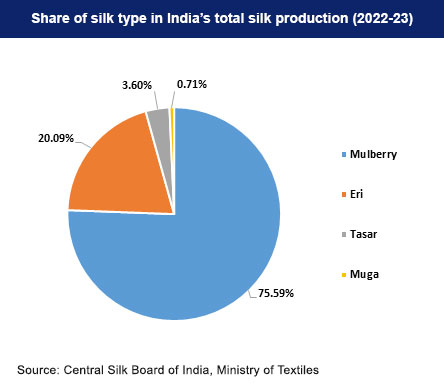
India produces a variety of silks as shown in the chart below:


Image credit.

Mulberry silk has the largest share of silk production in India, as well as globally. This particular type of silk is obtained from the larvae of the cultivated silkworm species known as Bombyx mori and gives the most prized, shiniest silk. 

Woven paisleys on the aanchal of a handloom
Bishnupur silk from West Bengal.


The others make up less than a quarter of the production volume. These are from species found in the wild, they give a so-called 'poorer' quality, more uneven textured, less bright and less dyeable silk. Some silks are also obtained from 'spent' cocoons i.e. the cocoons from which the metamorphosed insect has flown out. These are called Ahimsa or peace silks, they are particularly favoured by faiths that forbid the taking of animal life e.g. Buddhism, Jainism. 


Bengal cotton handloom with plain borders of Muga silk
and narrow Muga stripes in the body. A gift from my
grandmother in the mid-70s. 


The vast majority of mulberry silk is produced in the southern states of Tamil Nadu, Karnataka, Andhra Pradesh and in the east in West Bengal. Two other varieties are produced in Assam mostly, Muga especially is GI tagged to Assam. Eri is produced in other North Eastern states also. We'll get into more details of these silks in subsequent posts.  


~~~


Did you know that silk is basically protein? The shimmery quality of silk comes from the intrinsic properties of the filament. The silk filament is made up of two kinds of proteins - an inner core of fibroin and an outer covering of sericin which holds the filament together like glue. Fibroin is smooth, has a prism like structure and can refract light at different angles. Sericin is uneven textured. The degumming process removes the sericin and exposes the fibroin. The sheen of silk therefore depends on the extent of degumming. Read more here. 


Thank you for reading. And happy A-Zing to you for the rest of the challenge if you are participating. 


A-Z Challenge 2025 

Saturday, 12 April 2025

K is for... Knock out ... n ... Keepsake


All this month I am writing about killer Indian handlooms, a quick but knock out round with the saree specifically, a garment worn by Indians for five millennia. Come with me into the amazing, complex and utterly fascinating world of fibre and yarn, of skills and techniques of dyeing and printing and embroidery, traditions unchanged for centuries. Of sumptuous finished fabrics that not only make a fashion statement, but also constitute our cultural heritage and political identity.


K is for Korvai Kanchipuram


Kanchipuram sarees are named after the town they are woven in - the South Indian town of Kanchipuram, sometimes misspelled/ mispronounced as Kanjivaram. These are some of the most luxurious, ornate and traditional silk sarees woven in India, and are a must-have in every saree lover's wardrobe. 


My very first traditional saree was a maroon coloured Bengal handloom, quickly followed by a plain woven, thick Kanchipuram silk in a deep shade of teal, with white contrast borders and two lines of 'Rudraksha' motifs running in them. The silk was more than 5X the price of the cotton handloom, which was in itself pricey because it had 'wild' silk borders and silk stripes running through the cotton yarn. The Bengali weave was a gift from my grandmother who passed away a couple of years later. The saree is still with me as a keepsake. Sadly, the Kanchipuram saree  has been lost, I'm not sure how or when. 


Kanchipuram silks are characterised by Korvai borders. These are borders in contrasting colours woven separately on the same loom side by side with a special interlocking technique. It requires two weavers sitting at each end of the loom, sometimes three for complicated borders. That naturally raises the labour costs. 


Close up of Kanchipuram silk borders. You can
spot the slight uneven edge where the border
has been interlocked with the body while 
weaving. A Korvai border distinguishes a real 
Kanchipuram silk from an imitation. 


Now, add in the fact that silk is anyway a far more expensive fibre than cotton, also that gold threadwork and motifs are often incorporated into the sarees, so that  makes Kanchipuram sarees one of the most luxurious and costly sarees woven, usually reserved for bridal trousseaus and the most grand occasions. Watch a short clip on how a Korvai border Kanchipuram saree is woven below:


The origins of Kanchipuram silks is lost in the mists of time. I'll just give you some facts and you can draw your own conclusions -

1) Indian epics and the Vedic literature, dated to around 1500 BCE minimum, mention hiranya vastra or a 'garment of gold' that clothed the gods and epic heroes and their queens. 

2) Silk weaving was known in the Indus Valley Civilisation. Recent excavations show that sericulture with local silkworms was practised at IVC sites in 2000-2500 BCE. 

3) The Arthashashtra, a comprehensive 4th-century treatise on statecraft, economic policy and military strategy attributed to Chanakya (a native of South India) mentions a silk weavers guild. 

4) The oldest temple in Kanchipuram was erected by a Pallava dynasty king in the 7th century, as we shall see later silk weaving is innately connected to temples and royalty.  

5) The weavers themselves tell of myths in which  goddess Parvati wove her own bridal silks for her wedding with Lord Shiva. She taught the art to a sage called Markandeya who then passed it onto his disciples. 


The accepted view is that Kanchipuram silks originated in the 7th century as the temple town was established  by the Pallava dynasty and the weaver community came to settle there. Majority, roughly 80% of mulberry silk production in India happens in the four southern states of Andhra Pradesh, Tamil Nadu, Kerela and Karnataka, so the raw material for weaving is abundantly available. Silk weaving in India has been traditionally associated with royalty and temple towns, as silks were worn by kings and queens, and were also offered to the deities in the temple. Many of the motifs found in the Kanchipuram saree can be seen carved in stone in many places among the thousand temples of Kanchipuram.


The Kanchipuram saree is considered an integral part of South Indian, especially Tamil culture. The silks have been awarded the GI tag to protect their authenticity and prestige value. As they are so costly, cheaper powerloom imitations abound. I'm not sure how I feel about this - on the one hand, it is distressing that imitations fool the public and shrink the market for handlooms. They take away the rightful remuneration that is due to the weavers of the real thing. On the other, the reality of my country is that the vast majority of Indian women cannot afford a real Kanchipuram silk. Why shouldn't a bride from an economically underprivileged background wear something that she feels looks as good even if it is a copy? As with most issues in India, the answers are always knotty.


Watch a video on the Kanchipuram saree weaving below. 


This short video on a master weaver is also great to watch: 


~~~


Did you know that there is no need to keel over at the cost of Kanchipuram silks? Because Kanchi cotton handlooms are also a thing - sarees woven in cotton, less lavish use of fancy golden silver motifs, less blingy and equally great to wrap yourself in. Very smart for everyday use and an absolute knock out in summer, far more komfortable oops! comfortable when temperatures soar.


Thank you for reading. And happy A-Zing to you if you are participating in the challenge. 


A-Z Challenge 2025