Monday, 14 April 2025

L is for ... Love ... n ... Labour


All this month I am writing about the luscious Indian handlooms, a quick but captivating dive into the saree specifically, a garment worn by Indians for five millennia. Come with me into the amazing, complex and utterly fascinating world of fibre and yarn, of skills and techniques of dyeing and printing and embroidery, traditions unchanged for centuries. Of sumptuous finished fabrics that not only make a fashion statement, but also constitute our cultural heritage and political identity.


L is for Loom...obviously!

This animation below shows the process of weaving. Basically, weaving consists of three different motions - 1) the raising of some of the warp yarns (called shedding) creating a space between the raised yarn and the resting warp yarns 2) the  throwing of the shuttle with the weft yarn to travel between the 'shed' (this is called picking) and 3) the motion to gather the weft yarn thrown across the shed flush and tight into the final woven fabric (beating, battening). 


The basic loom was devised many thousands of years ago. Most archaeologists/historians agree that the loom developed in several cultures in Asia, Europe and the Americas, independent of each other.

Textiles do not survive over any length of time, they tend to decay. Even wood falls apart. Therefore most of the archaeological evidence for textile weaving comes from representations - sculpture in stone, on ceramic or rock art, and from the equipment like spindles, warp weights (we'll see in a minute what they are) and needles. The oldest archaeological evidence of weaving actually goes back to the Paleolithic (Stone Age), confirmed through a study done in the 1990s/2000. Read more about this fascinating search for these 'soft technologies' employed by Paleolithic humans here, here and here. 

What these studies show is that weaving was already happening some 28-30,000 years ago, and it was sophisticated enough that researchers felt textiles must have been woven for many years prior to get to that stage of advancement. How the loom has evolved from the Paleolithic to modern times is covered briefly in this article.


In India, textile evidence goes back to around 6000 years with earliest surviving yarns dated to 4000 BCE. And dyed fabrics have been dated to around 2500 BCE. Remember how Indigo was named 'the blue dye from India' by the Ancient Greeks? Weaving and indigo dyed cotton textiles were practically synonymous with India in the ancient world. 


Excavations in the Indus Valley Civilisation sites have yielded copper sewing needles, buttons, spindles, wool and cotton yarns. Cotton seeds have also been found. So from the archaeological evidence, cotton cultivation and textile weaving were quite established in the IVC by around 2500 BCE.  Indirect evidence comes also from Vedic literature (1500 - 500 BCE). These texts mention unstitched lengths of cloths covering the upper and lower body, the use of wool, silk and hiranya vastra or 'cloth of gold.' 


There were basically two types of looms from antiquity till the middle ages. The earliest looms we have evidence of are the warp weighted frame looms in which the warp yarns were tied to a beam at the top and kept in place by weights of terracotta/stone at the bottom, as illustrated on this vase from Ancient Greece. These weights from antiquity have been excavated in many sites across Asia and Europe. 


Image credit

The draw loom was invented around 300-400 BCE. This loom required two people, the main weaver and an assistant (a draw-boy, usually a slave) to operate a figure harness that could raise separate groups of warp yarns and weave pretty complicated patterns.  The dobby (a corruption of the term draw-boy) mechanism was introduced in the 19th century, which replaced the assistant. The Jacquard loom, where a series of punched cards controlled the warp yarns to be raised, was introduced a few decades earlier than the dobby.   


Image credit

As is evident from both the images, weaving was women's work all through antiquity, at least in the West. Even royal women were expected to spin and weave.  Think of the princess pricking her finger on a spindle in the fairy tale, or Queen Catherine making and mending Henry VIII's shirts in Tudor England. Women did all the weaving and spinning - it was considered a 'domestic' skill. That's why the multi-spindle spinning device invented in the 18th century was called 'Spinning Jenny' and not 'Spinning Jack' (though the inventor of the device was a man.) 


As  always, the labour and love ordinary women put into textile production no contemporary historian has recorded. It is only now that archaeologists and historians are trying to piece together the textile stories of the past. Read about one such study in this fascinating article on Viking textiles. 


The Industrial Revolution started with the invention of the 'Spinning Jenny' and the power loom in the 18th century. Textile production moved from a cottage scale women's domestic activity to factory based commercial production. We've seen in an earlier post what these advancements, combined with ruthless colonial control, did to the handlooms industry in India. 


Talking about Indian textiles, it is not crystal clear if weaving was as genderised in the Indus Valley Civilisation as it seems to be in the West, the jury is still out on that one. And from what little I know of Mughal princesses, they never did an iota of actual housework themselves, were not even schooled in any practical domestic skills, but were instead educated in religious studies, music, poetry, literature, languages, calligraphy, sciences of their times, and the arts, to be able to take their place in royal life confidently. Mostly lofty pursuits of the idle rich, no weaving or spinning, though Mughals themselves were great patrons of arts and culture and all aesthetic pursuits. Textiles grew and expanded under Mughal rule (1526 - 1857), but I'd imagine most of the spinning, weaving, dyeing and embroidery was left to the hoi polloi.  


With one exception. I've read that Aurangzeb, the grandson of Jehangir and the longest reigning Mughal emperor, was one grumpy austere religious fanatic - he made and sold the Islamic prayer caps by the dozen so as not to dip into the royal treasury for his personal expenses. A pious Muslim, he wrote out copies of the Quran in his own hand when he wasn't expanding the empire or taxing the living daylights out of the his subjects. He was an illiberal exception and very unlike the rest of the Mughals. I don't see his daughter Zebunnisa, (an accomplished poet and calligrapher, well versed in several languages, philosophy, mathematics and astronomy) or any of her four sisters, weaving or spinning. So no - Indian princesses didn't produce textiles in any noteworthy way. 


By and large we see both men and women involved in weaving handlooms in modern India.  In weaving communities, entire families are involved in handloom production. However, women do outnumber men - the Fourth Handloom Census in India 2019-20 indicates that an overwhelming 72% of the workers in the handloom industry are women. Even in the organised textile mills in India, over 60% of the workforce is female. 


L is also for Leheriya


Since this has already exceeded all decent word limits, keeping this brief.  Leheriya is a tie dye method which yields colourful diagonal stripes or chevrons. 


The word itself derives from the Sanskrit word 'Lahar'  which means wave. It is a fabric from Rajasthan, a desert state located on the western border of India, and the patterning is thought to echo that of the ripples on the sand dunes.  Women wear the patterns in sarees and odhnis/dupattas, a long strip of fabric used to cover the upper torso and head. Men wear it too, in turbans. 


The earliest known samples of Leheriya are dated to the 17th century. Leheriya has a deep significance in Rajasthani culture and is worn at family celebrations and religious festivals. Many communities/regions within Rajasthan have their own signature Leheriya patterns and colourways (like the Scottish clans with their plaids.) Read more here and here.


~~~


Did you know that the loom predates the wheel as an invention? Yeah, me neither...but on second thoughts, that's quite logical really...a coat is more of an urgent priority than a set of wheels...


Thank you for reading. And happy A-Zing to you if you are participating in the challenge. 


A-Z Challenge 2025 

Saturday, 12 April 2025

K is for... Knock out ... n ... Keepsake


All this month I am writing about killer Indian handlooms, a quick but knock out round with the saree specifically, a garment worn by Indians for five millennia. Come with me into the amazing, complex and utterly fascinating world of fibre and yarn, of skills and techniques of dyeing and printing and embroidery, traditions unchanged for centuries. Of sumptuous finished fabrics that not only make a fashion statement, but also constitute our cultural heritage and political identity.


K is for Korvai Kanchipuram


Kanchipuram sarees are named after the town they are woven in - the South Indian town of Kanchipuram, sometimes misspelled/ mispronounced as Kanjivaram. These are some of the most luxurious, ornate and traditional silk sarees woven in India, and are a must-have in every saree lover's wardrobe. 


My very first traditional saree was a maroon coloured Bengal handloom, quickly followed by a plain woven, thick Kanchipuram silk in a deep shade of teal, with white contrast borders and two lines of 'Rudraksha' motifs running in them. The silk was more than 5X the price of the cotton handloom, which was in itself pricey because it had 'wild' silk borders and silk stripes running through the cotton yarn. The Bengali weave was a gift from my grandmother who passed away a couple of years later. The saree is still with me as a keepsake. Sadly, the Kanchipuram saree  has been lost, I'm not sure how or when. 


Kanchipuram silks are characterised by Korvai borders. These are borders in contrasting colours woven separately on the same loom side by side with a special interlocking technique. It requires two weavers sitting at each end of the loom, sometimes three for complicated borders. That naturally raises the labour costs. 


Close up of Kanchipuram silk borders. You can
spot the slight uneven edge where the border
has been interlocked with the body while 
weaving. A Korvai border distinguishes a real 
Kanchipuram silk from an imitation. 


Now, add in the fact that silk is anyway a far more expensive fibre than cotton, also that gold threadwork and motifs are often incorporated into the sarees, so that  makes Kanchipuram sarees one of the most luxurious and costly sarees woven, usually reserved for bridal trousseaus and the most grand occasions. Watch a short clip on how a Korvai border Kanchipuram saree is woven below:


The origins of Kanchipuram silks is lost in the mists of time. I'll just give you some facts and you can draw your own conclusions -

1) Indian epics and the Vedic literature, dated to around 1500 BCE minimum, mention hiranya vastra or a 'garment of gold' that clothed the gods and epic heroes and their queens. 

2) Silk weaving was known in the Indus Valley Civilisation. Recent excavations show that sericulture with local silkworms was practised at IVC sites in 2000-2500 BCE. 

3) The Arthashashtra, a comprehensive 4th-century treatise on statecraft, economic policy and military strategy attributed to Chanakya (a native of South India) mentions a silk weavers guild. 

4) The oldest temple in Kanchipuram was erected by a Pallava dynasty king in the 7th century, as we shall see later silk weaving is innately connected to temples and royalty.  

5) The weavers themselves tell of myths in which  goddess Parvati wove her own bridal silks for her wedding with Lord Shiva. She taught the art to a sage called Markandeya who then passed it onto his disciples. 


The accepted view is that Kanchipuram silks originated in the 7th century as the temple town was established  by the Pallava dynasty and the weaver community came to settle there. Majority, roughly 80% of mulberry silk production in India happens in the four southern states of Andhra Pradesh, Tamil Nadu, Kerela and Karnataka, so the raw material for weaving is abundantly available. Silk weaving in India has been traditionally associated with royalty and temple towns, as silks were worn by kings and queens, and were also offered to the deities in the temple. Many of the motifs found in the Kanchipuram saree can be seen carved in stone in many places among the thousand temples of Kanchipuram.


The Kanchipuram saree is considered an integral part of South Indian, especially Tamil culture. The silks have been awarded the GI tag to protect their authenticity and prestige value. As they are so costly, cheaper powerloom imitations abound. I'm not sure how I feel about this - on the one hand, it is distressing that imitations fool the public and shrink the market for handlooms. They take away the rightful remuneration that is due to the weavers of the real thing. On the other, the reality of my country is that the vast majority of Indian women cannot afford a real Kanchipuram silk. Why shouldn't a bride from an economically underprivileged background wear something that she feels looks as good even if it is a copy? As with most issues in India, the answers are always knotty.


Watch a video on the Kanchipuram saree weaving below. 


This short video on a master weaver is also great to watch: 


~~~


Did you know that there is no need to keel over at the cost of Kanchipuram silks? Because Kanchi cotton handlooms are also a thing - sarees woven in cotton, less lavish use of fancy golden silver motifs, less blingy and equally great to wrap yourself in. Very smart for everyday use and an absolute knock out in summer, far more komfortable oops! comfortable when temperatures soar.


Thank you for reading. And happy A-Zing to you if you are participating in the challenge. 


A-Z Challenge 2025 

Friday, 11 April 2025

J is for. .. Jaw dropping ... n ... Jama


All this month I am writing about the jaw dropping Indian handlooms, a quick but captivating dive into the saree specifically, a garment worn by Indians for five millennia. Come with me into the amazing, complex and utterly fascinating world of fibre and yarn, of skills and techniques of dyeing and printing and embroidery, traditions unchanged for centuries. Of sumptuous finished fabrics that not only make a fashion statement, but also constitute our cultural heritage and political identity.


J is for Jehangir, Jama and Jamdani


Remember Jehangir? He was the Mughal Emperor who, in 1608, granted the British East India Company the first trading licence to set up a 'factory' (trading station) in India. At the time, the Mughal Empire was well established, Jehangir's great grandfather Babur, a descendant of Tamurlane and Genghis Khan, had landed up in India in the 1520s, and Jehangir's father Akbar had expanded and consolidated the Empire. Jehangir himself was a great patron of arts and culture and every art and industry, including textiles, flourished under him and his fashion forward consort Nur Jahan. 


The Mughals had brought with them a swathe of Islamic religio-cultural influences from their original homeland, part of the Persian Empire,  and they'd happily meshed it with the traditional richness of the millennia old Indian civilisation.  In fact, very few imperial dynasties have had the artistic astuteness and refined aesthetics that the Mughals possessed, expressed with a striking consistency through architecture, literature, libraries, music, painting, calligraphy, food, and of course, last but not the least, jewellery and apparel. (It's telling that the word 'mogul' has entered the English language and continues to mean a powerful person of great importance/influence.)


The first reference we have to Jamdani weaving is a sash around Jehangir's waist in a 17th century painting. The word 'Jamdani' is of Persian origin comprised of two separate words meaning 'flower'  and 'container.' 

Detail from a Jamdani handloom cotton. Note the
sheerness of the fabric - the motifs on the inner
folds are visible through the top. This is however,
not even close to the transparency the original
Muslin weavers achieved. 


The gossamer fine cloth with these striking motifs has always been associated with Bengal, with Dhaka which is now in Bangladesh. Dhaka's history goes back to around the 6th century and it has been the traditional centre of handloom weaving. Xuan Tsang, a Chinese traveller to India (629-45 CE) compared the fabrics woven there to 'light vapours of dawn.'  Arab traders have referenced these superbly delicate cotton handlooms in the 9th century as 'fine enough to pass through a signet ring.'  Poets of the Mughal court called them 'baft hawa' or woven winds, 'abrawan' - flowing waters and 'shabnam' - evening dew, all lyrical names highlighting their lightness and transparency. Akbar, Jehangir's father, had reserved the finest, most transparent and delicate of these fabrics solely for royal use. This fabric came to be known in the West as Muslin. Jamdani was a flowered muslin, considered to be one of the most complex and advanced handloom weaving art. 


Motifs on a W. Bengal Jamdani handloom cotton sari.


In the 18th century, the Muslin industry was lost as the EIC systematically destroyed the Indian textile industry. But mercifully Dhakai Jamdani weaving survived and was declared an intangible cultural heritage of Bangladesh by UNESCO in 2013.


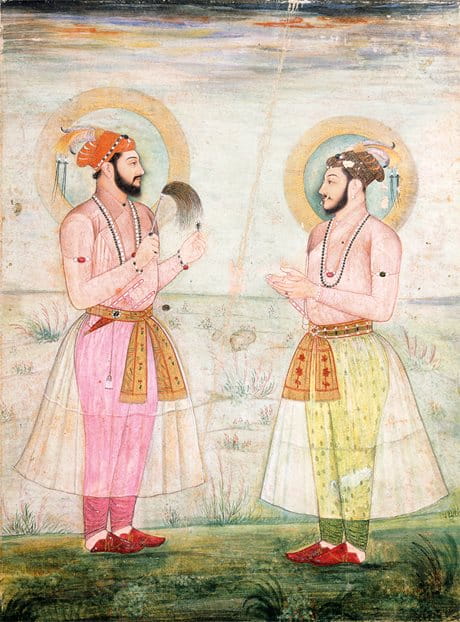
Image source. Mughal princes in Muslin 'jama'
a long coat/robe. Note the original sheerness.


What exactly is Jamdani weaving? It is a discontinuous weft technique, where a special tool called a 'Kandul' is used to inlay motifs into the weft of the fabric as it it being woven, so that the sheerness or weight of the fabric is not affected.  It is considered to be the most advanced, complicated handloom weaving technique, demanding a high level of skill and knowledge. Watch this video to see how a jamdani saree is woven:


Originally, jamdani sarees were woven in a cluster around Dhaka. Some weavers migrated to weaving hubs near Calcutta and brought jamdani weaving to other parts of Bengal. Today jamdani weaving is done not just in Bengal but also in several other parts in the North, South and Central parts of India.  Read more about Indian Jamdani weaving here and here. 


Jamdani from India. These motifs are not embroidered 
or printed on the fabric, but woven into the weft 
simultaneously by employing an extra, special tool.


Detail of a motif. Front view. 


Detail of motif. Back view. 

Note how the yarn making the pattern is woven into the weft and finished without any loose ends. Also, the pattern isn't traced anywhere on the fabric, in fact there is no fabric to trace patterns on, as only the warp yarns are fixed on the loom as weaving begins. Sometimes, the more complicated jamdani patterns are drawn on a template or graph paper and held below the fabric as it is woven. Often, the master weavers weave without any patterns at all, relying on experience and the cumulative knowledge/skills handed down for many generations. 


J is for Jeopardy

...which is what the entire Indian handloom sector is in - because of cheaper machine made substitutes and the lack of interest on the part of the younger generations.  Read about some of the challenges the weavers face here. 

~~~


Everyone knows about Ancient Rome's fascination for Indian textiles, but did you know that Indian handlooms once travelled East as well, to Japan? In the 17th century, Indian textiles were popular in Edo, the former name of Tokyo. Even today, Japan remains a significant importer of Indian handloom goods. There are Japanese enterprises which collaborate to keep these historical ties alive. Read about one of them here. 


Thank you for reading. And happy A-Zing to you if you are participating in the challenge. 


A-Z Challenge 2025 

Thursday, 10 April 2025

I is for... Incredible ... n ... Iconic


All this month I am writing about the iconic Indian handlooms, a quick but captivating dive into the saree specifically, a garment worn by Indians for five millennia. Come with me into the elegant, complex and utterly fascinating world of fibre and yarn, of skills and techniques of dyeing and printing and embroidery, traditions unchanged for centuries. Of sumptuous finished fabrics that not only make a fashion statement, but also constitute our cultural heritage and political identity.


I is for Ikat 


Now what can I say about Ikat? It is one of my absolute favourites among Indian handloom styles. Offhand, I'd say more than 20% of my wardrobe is made up of Ikat. When you consider that India has an incredibly diverse range of handloom sarees (The Handloom Development Commissioner lists  more than 100 types), having a fifth dedicated to just one style shows some positive bias, right?


What is Ikat exactly? Put simply, it is a resist dyeing technique. In which the yarn is arranged on a frame, progressively tied and dyed in multiple colours of the final pattern before weaving. As the yarn is then woven and the threads lined up, the pattern takes shape on the loom. Much easier said than done, as you can imagine, especially when there are multiple colours and complicated patterns involved. Note that an ikat patterned saree has no right or wrong side, since it is the yarn that is dyed the pattern comes out uniform on both sides of the fabric. 


As a kid in Delhi, I had visited a trade fair where master weavers had showcased all the steps of this complex, lengthy, super labour intensive and utterly spellbinding process. One of the artisans there had explained how an Ikat saree might take a full six months from design to finished off the loom. I fell irrevocably in love with this incredible textile and have never recovered. I wore my first Ikat saree as a teenager, wore an Ikat for my pre-wedding rituals and continue to wear them at dressy occasions as well as regular, not so dressy ones. In short, I can't imagine life without Ikat sarees!


Watch a video of an Ikat saree being created:


The word Ikat comes from the Malay/Indonesian phrase 'to tie.' It is one of the most ancient fabric weaving/patterning techniques, thought to date back to Neolithic times, first evolving somewhere in mainland Asia and travelling outwards as far as Madagascar and the Americas. In modern times, it is most widely used in Indonesia. Indian Ikat may have originated independently though, as the oldest evidence of Indian Ikat has been found in an Egyptian Pharoah's tomb, traced back to Odisha in the East Coast of India. 


There are two kinds of Ikat - single (tied weft or warp thread patterns) and double Ikat (both warp and weft are tied). Ikat sarees are traditionally woven in Gujarat, Telengana and Odisha in India. Both single Ikat and double Ikat sarees are woven. Single Ikats are characteristically blurry along one dimension, and little more subtle, while double Ikat patterns are blurry all round but also bolder and crisper. Apart from sarees Ikat fabrics are popular in stitched garments and home furnishings as well. Ikat is now seen on handlooms of Bengal as weavers innovate, as designs and techniques diffuse throughout India. 


Double Ikat silk Patola saree from Gujarat. Zoom in
to see the  detail of the multi-
colour tie dye pattern.


Double Ikat cotton saree from Telengana. 


Single Ikat cotton saree from Telengana.


Double Ikat Sambalpuri silk saree from Odisha. Note the
intricacy of the design on the body and the animal
 motifs on the aanchal - the deer, lion, and fish. 


Would it not be an inconsolable tragedy if these masterpieces died out?


I is also for Ichchhapuron, (lit wish fulfilment) a boutique in my home town Kolkata, created and run by Srilata Sen, a fashion designer with inputs from her young daughter Shubhroja Sen. They have curated an utterly scrumptious range of handlooms, hand-embroidered and hand-painted sarees from all over India. There's also a line of Indo-Westerns which Shubhroja is mostly involved in. They operate in USA as well through a tie-up based out of NJ and are licensed exporters shipping globally. Connect with them on FB, Insta and YT, and WhatsApp them at +91 99031 07213. 


~~~


Did you know that Indigo, an ancient dye obtained from the leaves of the Indigofera plant, is not itself blue? When the leaves and crushed and fermented, the brew is green and turns blue only upon oxidation. Indigo was so inextricably associated with India that the Ancient Greeks named the dye/plant/colour after the country, they called it 'Indikon' or the 'blue dye from India' from which the word Indigo is derived.


Thank you for reading. And happy A-Zing to you if you are participating in the challenge. 


A-Z Challenge 2025 

Wednesday, 9 April 2025

H is for ... Hank ... n ... Host


All this month I am writing about the beauty of Indian handlooms, a quick but captivating dive into the saree specifically, a garment worn by Indians for five millennia. Come with me into the elegant, complex and utterly fascinating world of fibre and yarn, of skills and techniques of dyeing and printing and embroidery, traditions unchanged for centuries. Of sumptuous finished fabrics that not only make a fashion statement, but also constitute our cultural heritage and political identity.


H is for Hurdles


...of which there are many that the handlooms face. 

Incidentally, Indian handlooms comprise a humongous range - from carpet and rugs woven in Kashmir to the humble checked 'Gamchha' (lit 'body-wipe') in Bengal and Odisha, often seen slung over working class men's shoulders as they go about their work in fields and towns. From the highly refined 'woven-wind' fabrics for the elite to the coarsest ones for humdrum, everyday needs,  employing a huge range of fibres - every possible ply in wool, silk, linen, cotton and jute as well as some manmade ones. Obviously, the range of challenges faced is also equally as broad - sourcing hanks of yarn to marketing the finished goods, there are a plethora of issues, and each regional handloom sector has its own particular set of challenges. These must be understood at the local levels and solutions must be fine tuned to suit individual regional/cluster requirements.


The latest Handloom Census conducted in 2019-20 highlights these broad issues :


1. The Central government budget allocations for the handloom sector has fluctuated in the last decade. The allocation dropped overall to INR 200 crores in 2022-23 from INR 493.50 crores in 2013-14. Less than halved!

2. The market is fragmented and procurement of raw materials - hanks to dyes to finishing products, is not always smooth or easy. Cost of fibre is of particular concern. Awareness of government support schemes is poor among most weavers. Delays in realisation of amounts is also an issue.

3. Credit, working capital, a whole host of financial issues. Some weavers get caught in a debt trap because banks do not consider them creditworthy so they are forced to borrow from unscrupulous loan sharks. (Read more here) 

4. Market access is a weakness, though some weavers are making use of online platforms to try and gain entry to newer markets. 

5. Erosion and/or loss of traditional skills. Handloom weaving skills have been passed on generationally for centuries. However, due to relatively poorer financial remuneration, the sons and daughters of traditional weaving communities are turning to other professions.

6. Competition from mass produced cheaper powerloom copies. The truth is that these will always be available at much lower price points than handlooms. Some attempts to protect handlooms have been made through the Handlooms Reservation Act 1985 and GI tags. 

7. Consumer awareness about the uniqueness and exclusivity of the handlooms is low. The generation that grew up with handlooms is dying, the newer generations are not fully aware of the heritage values or history.


Read more here and here. 


I'm hopeful though. Ethnic wear is enjoying a resurgence and Indian handlooms are being seen on Western as well as Indian catwalks. Large corporates have entered the handloom market, among them the Tata's with their brand Taneira. I'm particularly happy about that, because they entered the Indian watch and jewellery markets in the 90s and completely transformed the whole market ecosystem. What's not to say they won't do the same with handlooms? 


And here is a video that highlights the history of some key handlooms from various parts of India:


~~~


Did you know that the Elephant (Hathi in Hindi/Bengali) is an Indian traditional motif in both woven, printed and embroidered textiles?  It is a symbol of strength with gentleness, grace, majesty, royalty, intelligence, long memory and worshipped as an earthly representation of Lord Ganesha of the Hindu pantheon. 


Image Source


Thank you for reading. And happy A-Zing to you if you are participating in the challenge. 


A-Z Challenge 2025 

Tuesday, 8 April 2025

G is for Great ... n ...Garment


All this month I am writing about the gorgeousness of Indian textiles, a quick but captivating dive into the saree specifically, a garment worn by Indians for five millennia. Come with me into the elegant, complex and utterly fascinating world of fibre and yarn, of skills and techniques of dyeing and printing and embroidery, traditions unchanged for centuries. Of sumptuous finished fabrics that not only make a fashion statement, but also constitute our cultural heritage and political identity.


G is for Ganga Jamuna


Ganga Jamuna is not a type of saree per se, it is a classic border design which features two disparate, often high contrast colours for the top and bottom borders.  'Ganga Jamuna'  refers to the two great rivers of course, the Ganges and its largest tributary the Yamuna - the lifelines of India. These two rivers rise in the North and flow through a total of 11 Indian states/provinces then drain into the Bay of Bengal in the East through Bangladesh (a part of India till 1947). 


Classic Ganga Jamuna borders
in a red n green combo. 


Incidentally 'Ganga Jamuna' in the Indian context is a metaphor for the syncretism that exists in the blend of two separate Hindu-Muslim subcultures,  as in 'Ganga Jamuni tehzeeb' (culture). Separate, contrasting, equidistant throughout but complementary to each other and woven together. 


It is also interesting to note that the body of the saree is referred to as 'jomi' and the borders as 'paaR' in Bengali, which are the exact same words for land/field/earth and riverbank respectively. In other words, the saree here becomes a symbol of the river and its banks, of India itself. Poetic but also eminently true, no? 


There's also a colour called 'Ganga-jal' meaning 'Ganga waters', usually used on the body or 'jomi' of the saree  - a shade of sandy beige. Everywhere, geography shapes our roti-kapda-makaan (bread-garment-building) and also language. We end up wearing our culture, aware of it or not.


Okay, back to borders.  Initially the saree must have been a simple piece of plain fabric without any differentiated borders. However, evidence from the Mauryan period (321-185 BCE) indicated that sarees had developed ornate borders by then, which was further bolstered by all round advances in technological and cultural spheres in the Gupta Empire (320-550 CE), the classical Golden Age of Ancient India. In short, saree borders go back at least two millennia. 


And no wonder, because it makes eminent sense to have borders on a saree. The bottom edge is in constant contact with the feet/shoes/ground, while the top part is tucked or knotted around the waist, therefore both require extra strength fabric. Originally, the borders would have been purely functional, i.e. added for reasons of durability, later becaming a design element. By the 10th century, distinct regional textile traditions in both weaving and draping had been established. Read more here and here.


During medieval times, especially in the Mughal era, new techniques of embroidery and gold/silver thread work was introduced. The Mughals were great patrons of art and culture and promoted many new design innovations in textiles. Gold and silver were woven into borders, newer floral motifs were introduced through cultural exchange between Persia and India. Handloom weaves  became the epitome of luxury. 


It is not quite clear where or when the Ganga Jumana border originated. The term 'Ganga Jamuni' itself originated in Awadh in the 18th/19th century - to refer to the syncretic culture that developed under the Awadhi/Mughal rulers in the area bounded by the two sacred rivers - known as Doab, where major textile hubs like Varanasi (Benarasi weaving) and Lucknow (Chikankari shadow work embroidery) are located. 


It seems logical that the Ganga Jamuna border design could have originated somewhere within this setting also. Or perhaps the design element existed many centuries prior, but the name was adopted after the Awadhi term was coined? 


What is intriguing  is that the Ganga Jamuna border is now popularly woven in traditional regional handloom centres where neither the Ganga nor the Jamuna flow, such as Vidarbha in the West. And in places never part of the Mughal empire, where other major rivers also held to be sacred, like Kaveri and Thamirabarani, exist. Such as Kanchipuram, famous for its silk sarees since the 7th century. How has this come about?


All one can say that the Ganga Jamuna border is a timeless classic. 


~~~


Did you know that? - In Bengal, because the handloom cotton borders were woven to be so much more durable than the body they outlasted the saree and were kept and reused to edge seating mats called madur and asana. Also used as general purpose rope and ribbon. The threads pulled from the deconstructed border were used by ladies to embroider various household articles like pillow covers. 


Thank you for reading. And happy A-Zing to you if you are participating in the challenge. 


A-Z Challenge 2025